

Early Influences
For Calandrelli, growing up in West Virginia meant learning the value of perseverance early.
“Both of my parents grew up poor in the state,” Calandrelli says. “They worked incredibly hard to bring our family into the middle class, but even so, throughout my childhood the biggest topic when it came to careers was financial security. When you get older, not having money becomes one of your greatest sources of anxiety.”
Calandrelli turned to engineering not just for financial security but as a foundation for something larger—connecting science to the public and using her platform to make it more inclusive. She recalls two things she learned while pursuing this career field.
“I learned that it was adventurous and fun and that I was also good at it,” she says. “There was grit, but there was also this glory and payoff that came with it. I was able to fly in zero gravitational force while doing research. I lived in California, Cleveland and China and did different internships and research fellowships in different locations. I traveled the world and was paid for it because I was doing science and engineering.”
After Calandrelli earned her bachelor’s degree in mechanical and aerospace engineering from West Virginia University, her educational journey led her to Massachusetts Institute of Technology (MIT), where she received two master’s degrees in aeronautics and astronautics as well as technology and policy.
Breaking Barriers
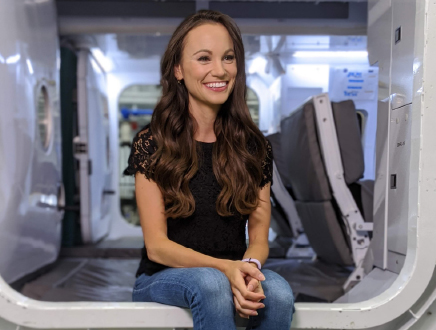
Calandrelli says one of the most significant obstacles she has faced thus far in her career is working in male-dominated fields—one being Hollywood. Transitioning from a STEM background to Hollywood has been a challenging yet rewarding experience for her.
“When I went to Hollywood—more specifically, science Hollywood—I thought they would be more progressive and open to a female being a scientist on TV,” Calandrelli says. “That was not the case.”
In 2014, she became the host of “Xploration Outer Space,” an educational show that aired on Saturday mornings. What she didn’t know at the time was that her new role marked a major milestone: she became the first woman to solo host a national science show in the U.S.
“I would love to say that 11 years later that glass ceiling has been shattered and we have dozens of female Bill Nyes hosting their own science shows on every network,” she says. “Unfortunately, that’s just not true.”
Only about 1% of science shows are solo hosted by women, a figure Calandrelli points to as evidence of an industry slow to embrace change. She suggests part of the problem lies in outdated assumptions about audiences.
“I think the biggest challenge is convincing Hollywood that America is ready to see female scientists on TV,” she says. “It’s not just about proving that men will watch female scientists but recognizing there are many women and girls who love science and want to see themselves represented.”
Calandrelli says this barrier isn’t unique to science programming—even in non-science television, people think women-led stories won’t sell well. In addition to gender bias, Calandrelli also faces the challenge of working in an industry that often favors animation over live-action educational content.
“Networks want to invest in cartoons when it comes to educational television,” she says. “Cartoons lend themselves better to toys and intellectual property, but by doing so, you create a role model gap.”
While animated characters may teach basic STEM concepts, Calandrelli believes real-life role models are essential.
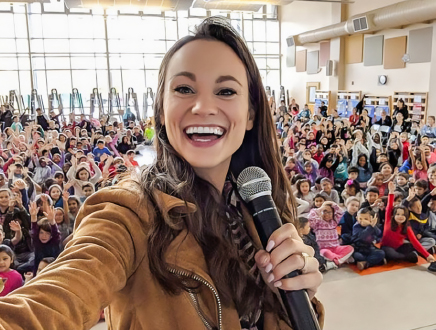
“How many kids were inspired to pursue science because of Jimmy Neutron?” she asks. “How many were inspired because of Bill Nye? There’s something about a real engineer—someone who truly cares about this work—that changes what kids believe they’re capable of.”
She also points out the financial motivations that make cartoons more attractive to networks.
“With cartoons, you don’t need to give anyone a raise,” she says. “If a show does well, it costs the same to produce season after season. You don’t have a person saying, ‘Hey, I helped make this successful—I deserve to share in that.’”
Despite the challenges, Calandrelli remains committed to creating space for women in science media.
Meaningful Milestones
In November 2024, Calandrelli became the 100th woman in space, a monumental accomplishment years in the making.
Calandrelli credits all the women who came before her, saying the opportunity to achieve such a milestone was fought and won by them.
“It was way harder for the first 50 women who fought for their place in this industry and paved the way for people like me to be able to simply fundraise to go to space,” she says. “We’ve all found a different path to get there, but the earlier women are the true pioneers who made it possible for the rest of us to be able to go.”
Originally, Calandrelli attempted to bargain with Blue Origin—the company that eventually hosted her space flight—to allow her to secure a seat before seeking fundraising to pay for it, on the promise that she would draw positive media attention surrounding the trip. However, the company was not willing to give her a seat before she financially secured it, and fundraisers would not sponsor her unless she had already secured a seat.
This led Calandrelli, with the support of her husband, to make the decision to sign on for the Blue Origin space flight, betting her own life savings and then looking to secure the funds for it. Calandrelli reached out to every brand partner she had worked with in the past to seek funding, and one notable yes she received came from Brad and Alys Smith at Marshall University.
“I love the fact that Brad and Alys Smith not only wanted to help Marshall but West Virginia as a whole,” she says. “Because of them, I was able to leverage this space flight to shine a huge spotlight on the state.”
Throughout her space flight, Calandrelli promoted the tuition support program Marshall for All, Marshall Forever. She says with the current cost of college tuition being so high, the program helps Marshall students get the education they deserve without having to stress about funding.
“I’m a huge believer that when you remove the financial aspect of the equation you can focus solely on being the best student possible, and Marshall for All, Marshall Forever helps more students do that,” she says. “I was extremely proud to be able to promote that and raise money for it.”
Calandrelli is among the select humans who have experienced space firsthand, but there is a growing influence of artificial intelligence (AI) in space exploration. She says while sending humans to space is fun and inspirational, robotic exploration can be much more practical.
“A robot is cheaper, easier and sometimes faster to develop and send because you don’t need to feed them,” she says. “They don’t need a bathroom and can work 24 hours a day. Robotic exploration is often a better bet, and that’s why most of the exploration that we’ve done throughout history has been with robots. It’s just cheaper and easier.”
Calandrelli explains that although it may be risky to rely too heavily on robotic exploration for now, the field is certainly expanding, and as AI progresses, it will likely be integrated into many space missions.
AI and technology also affect Calandrelli as a parent in this digital age. She suggests not all screen time is created equal and often uses modern technology to educate her children, limiting things like TV to 15 minutes a day but allowing her children to play math or reading games on their tablets. She says it is important to allow children to become familiar with technology as it will inevitably be a big part of their life when they’re older.
“I don’t think we should eliminate it altogether,” she says. “This is a tool that you will have in the real world and you should learn how to use.”
Educating & Inspiring
Calandrelli uses her expertise to educate children about science through her multiple shows and bestselling book series “Stay Curious and Keep Exploring.”
In 2020, she hosted “Emily’s Wonder Lab,” a Netflix series showcasing different science experiments children could do from home. The show lasted 10 episodes, and while Calandrelli had countless other science experiments she was ready to feature, Netflix did not pick up the show for another season at that time. She then decided to write about those experiments in her book series and develop a new show, “Emily’s Science Lab” on YouTube, with each episode demonstrating an experiment from the book.
“It was my way of taking control of my career and trying not to rely on anybody else,” she says. “It was a hard decision to make because as soon as I published the experiments in a book, they were no longer going to be interesting to Netflix. I knew that as soon as I published the books, I was closing that door, but it was my way of saying, ‘I’m not going to wait on you anymore. I’m going to take control of my own career.’”
Calandrelli is passionate about inspiring women and girls, which led her to collaborate with Morgantown-based jewelry company Silver Pennies Jewelry (SPJ) to create something for the women in her life.
She drew inspiration from pearls—natural agitators formed by the intrusion of something that was not supposed to be part of a system. She sees the women around her as agitators: Oftentimes the only women in the room, told they don’t belong and yet ultimately create something beautiful by being there.
“They have these beautiful flatbed pearls that are very unique,” she says. “That’s the other part of it I love. All my girlfriends are unique, so every single pearl is slightly different.”
SPJ also helped create jewelry from meteorites Calandrelli took with her to space.
“They came from space, and I brought them back up, so they’re space travelers,” she says. “I brought them to Silver Pennies Jewelry, and they’re helping me create some unique items with them, too.”
The SPJ collection is just one of many ways Calandrelli has supported her home state. She is also a steadfast advocate for causes like teacher appreciation and foster care. One of many examples is using her platform to attempt to fight against the policy prohibiting teachers from sharing wish lists so they get the resources they need for their classrooms.
She also chose to bring a flash drive to space full of wishes, encouraging donations with each wish, which ultimately raised more than $30,000 for foster care in West Virginia. This was alongside the $7,000 Calandrelli raised through the platform Cameo, resulting in around $40,000 altogether.
“Anytime I have the opportunity to help somebody, my focus always goes to, ‘Well, what if that somebody was in West Virginia? How do I find a way to direct the good to West Virginia?’”
Calandrelli sees herself and others who have excelled in their fields as kindred spirits with a shared desire to return home and use their success to uplift their state.
Elevating Aerospace Education
By Megan Bevins & Kenzie Dye
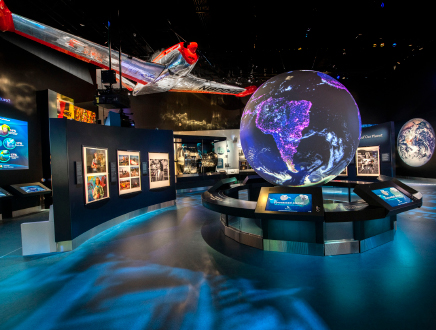
The Smithsonian’s National Air and Space Museum has been promoting education in spaceflight and aviation since 1946. With its main facility in Washington, D.C., and a second location—the Steven F. Udvar-Hazy Center—in Chantilly, VA, its collection exceeds 78,000 artifacts spanning every era of air and space history.
With the rapid development of cutting-edge technologies like artificial intelligence (AI) and robotics, the museum offers guests a chance to view real-world innovations first-hand. Jeremy Kinney, associate director for research, collections and curatorial
affairs at the museum, says one example is Robonaut 2, displayed at the Steven F. Udvar-Hazy Center. This is a humanoid robot assistant that was stationed at the International Space Station from 2011 to 2018 and performed functions such as flipping switches and handling tools.
“We are interested in learning how the museum community may use AI to shape how cultural institutions do their work in terms of collections care, exhibits and research,” Kinney says.
The new “Futures in Space” exhibit will further explore these potential technological developments. Emily Margolis, Ph.D., curator of contemporary spaceflight, says “Futures in Space” will include artifacts representing past and present activities in space as well as a forum for visitors to engage in conversations about current spaceflight. It will also host a stage for live programming and a presentation screen used to feature current news stories and stream launches and other space events.
“‘Futures in Space’ will be an exciting new gallery poised to capture space history as it continues to unfold,” Margolis says.
The museum also began a multi-year renovation of its National Mall Building in 2018, with the first eight galleries opening in 2022. There will be five new galleries opening in July 2025, and the fully renovated building will open in July 2026.
For those who cannot make it to either location in person, the museum has many digitized options to expand its knowledge to as many visitors as possible.
“While it is true the museum houses many one-of-a-kind historic and significant artifacts that are a must see, we know that presenting our key objects in digital form increases access and, with that, knowledge of aerospace history,” Kinney says.
To promote hands-on education, the museum hosts on-site and virtual learning programs. Kinney says one example is the Aviation Explorers camp, which allows 60 camp goers each summer to meet with experts, participate in design challenges and possibly fly with a certified flight instructor. The museum also hosts story-time presentations, videos and monthly air and space programs for families.
“Futures in Space” will feature a mockup of the Blue Origin New Shepard crew capsule that Science Communicator Emily Calandrelli flew to space last November. Margolis says the museum will feature the work of numerous public figures like Calandrelli who have helped expand the knowledge of space exploration over seven decades.
“We hope everyone will come to the National Air and Space Museum to make a personal connection to aerospace history,” she says.