

Michael T. Benson
By Kenzie Dye
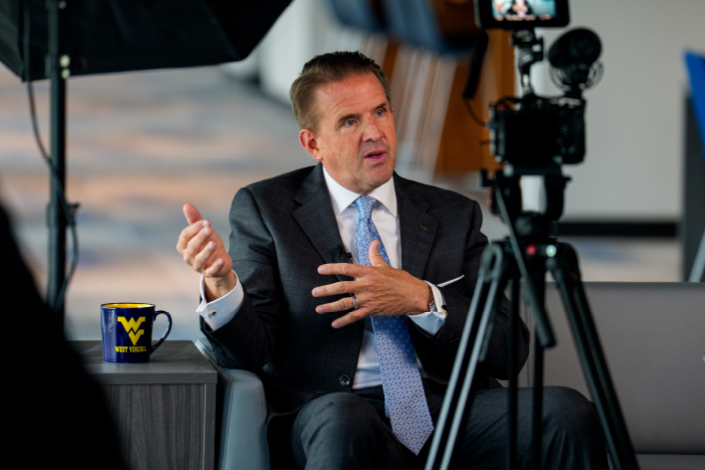
When Dr. Michael Benson stepped into his role as president of West Virginia University (WVU), he did so with a clear mission: to honor the legacy of the institution while preparing it for a bold, forward-facing future. With more than two decades of leadership in higher education and a rich personal history shaped by travel, family and a love for learning, Benson brings to Morgantown a deep appreciation for the power of education to change lives.
Benson is the youngest of six children. Born in Utah and raised in Dallas, Texas, his childhood was nomadic. He attended five different elementary schools in six years, which allowed him to learn how to make friends and adapt quickly.
At 19, Benson left the country for a two-year church mission in Italy, an experience he describes as transformative.
“It gave me a perspective on the world that you can’t get any other way than living outside of your native country, learning a different language and learning about a culture,” he says.
This global curiosity shaped his life goals, leading him to create a list of five places he wanted to live by the age of 30—Rome; Washington, D.C.; New York; London; and Jerusalem. Benson has lived in each of these cities for at least a year and a half, except New York. Despite his big-city ambitions, Morgantown has quickly made an impression.
“Somehow Morgantown didn’t make the list, but in retrospect, it should have,” he says.
Benson’s academic journey began at Brigham Young University, where he studied political science with minors in English and history.
“I love reading good writing, and I’ve gotten better as a writer, I believe. The ability to communicate through the written word is so important in this day and age,” he says.
His career path has included multiple university presidencies, the most recent being Coastal Carolina University in South Carolina. While Benson and his family enjoyed life there, WVU offered a challenge he couldn’t ignore.
“We were very happy in South Carolina, but I also knew in the back of my mind that as I had turned 60, I really wanted a big challenge in my career,” he says. “This is that big challenge.”
WVU’s uniqueness is what inevitably drew Benson to the role. The combination of land-grant and flagship status while being a Research 1 institution and having a comprehensive academic medical center is rare.
“The fact that we do not have what is referred to as medical islands anymore and that through our hospital network most people can get access to health care and services pretty readily is really remarkable,” Benson says.
Since taking office, Benson has focused on being visible and listening closely.
“I have really tried my best to be visible, to be out and about,” he says. “I think it is really important for me to be present and to listen. I come into this role not having all the answers, so I will rely on people from here who know the university better than I do.”
Internally, he is focused on strategy and leadership.
“We needed a strategic plan and clear path moving forward,” Benson says. “A new plan is in development, and it is very concise, aggressive and forward-facing. We’ve had some challenges in the past, but my job now is to focus on where we are and where we want to go.”
Benson’s perspective on West Virginians is one of admiration.
“I really appreciate how West Virginians are humble and self-effacing by nature,” he says. “I think people in many instances have doubted them, and they have this grit and work ethic that wants to prove people wrong.”
He sees that grit as central to WVU’s identity and future. While Benson is eager for what’s to come, he acknowledges the serious challenges facing higher education nationwide, especially the declining public confidence.
“Think of all the incredible discoveries, technologies and medical advances that have come from universities—I would argue in support of the value of particularly public higher education,” he says. “The more education citizens get, the more inclined they are to vote, the better their health will be and the more likely they are to participate in volunteer organizations or church congregations.”
Enrollment and finances are top priorities during this stage of Benson’s presidency at WVU. He says he is encouraged by enrollment numbers for the Fall 2025 semester but stresses the importance of stopping the decline of the student population. One way to do this is through the school’s finances and development of more creative revenue streams.
“You can only rely so much on tuition and fees or state appropriations. You have to do more with sponsorships, grants, contracts and private fundraising,” he says. “Last year, we raised $282 million, which I believe was a record. For a school this size and with our alumni base, we should be raising a minimum of $300 million in private support annually.”
Another priority for Benson while he’s president is strengthening partnerships, both statewide and locally.
“There has to be collaboration in order for Morgantown to be the best college town it can be,” he says. “If a prospective student visits with their family and you don’t have what they want in terms of residence halls, academic programs or safety, they’re going to go elsewhere. The university has to be a leader in partnering with all sorts of state agencies in addition to our local companies and national companies.”
For Benson, the transition to West Virginia personally and professionally has been overwhelmingly positive.
“People have been so incredibly gracious,” he says.
“Everywhere I’ve gone, my family and I have tried to leap in with both feet and make it our home. We intend to do that here.”
Looking ahead, Benson hopes to help bring the university’s current fundraising campaign to the finish line.
“I’ve never been a part of a billion-dollar private fundraising campaign,” he says. “To me, this is exciting because the money represents opportunities, whether it’s in the form of scholarships, faculty support, study abroad programs or a capital project for athletics.”
He also hopes to leave an impactful legacy at the university when his time as the president comes to an end.
“I want people to say, ‘Here was a gentleman and his family who moved to the Mountain State and immediately became part of the fabric of our community. They loved West Virginia, and West Virginia loved them, too,’” he says. “We are building on what is already a solid foundation but hope to leave it better than when we found it.”