

The future of education in the Mountain State is being shaped not only by educators and curriculums but also by the spaces where learning takes place. Across West Virginia, education leaders and architectural firms are reinventing the wheel when it comes to meeting the needs of a new generation of students. Modern school buildings must be flexible, technology-driven, safe and welcoming to students and the communities they serve.
The School Building Authority of West Virginia (SBA) has been at the forefront of this effort for more than three decades, investing in facilities that give every student access to equitable learning environments.
“The SBA emphasizes high-performance school design, incorporating strategies such as daylight and good indoor air quality as well as thermal and acoustic comfort, all to enhance student focus, health and academic outcomes,” says Executive Director Andy Neptune. “Students have demonstrated that these qualities lead to improved test scores and attendance while reducing disruptions.”
Safety is a top priority in all projects the SBA funds.
“Controlled access to main entrances is mandatory, along with coordination with local law enforcement and emergency services,” Neptune says. “Facilities incorporate secure vestibules, clearly defined entry points, bus and parent drop off zones and administrative offices placed at the front with the ability to monitor entrances. The SBA also guides ADA compliance, accessible internal circulation, connectors between buildings, proper restrooms, HVAC and daylight strategies to support inclusivity and comfort.”
Equity also drives the SBA’s mission. Neptune says many of the SBA’s NEEDS Grants and Major Improvement Projects are prioritized for rural or low-income counties facing aging infrastructure, safety deficiencies or overcrowding. He refers to projects such as the $15.7 million pre-K-8 facility in Wyoming County, which replaced an aging wood structure, and the $15.6 million consolidation of two Fayette County schools into the new Midland Trail Elementary. From new school builds such as these to major renovations like White Sulphur Springs Elementary in Greenbrier County, students and educators are seeing the benefits firsthand.
“In both of these examples, district heads credited SBA support with both improved learning environments and teacher retention,” Neptune says.
In West Virginia’s independent higher education sector, campus facilities play a vital role in academic outcomes and overall experiences for students. Ben Beakes, executive director for West Virginia Independent Colleges and Universities, says the connection between learning spaces and students is clear. He shares Neptune’s
sentiment that the quality of air, natural lighting and temperature are important but also touches on the importance of first impressions.
“The quality of facilities is one of the first impressions colleges and universities make on prospective and current students,” Beakes says. “They can serve as a recruitment and retention tool or a deterrent. Being clean is not enough. Our students should have the ability to visualize themselves learning and growing both academically and
socially in our facilities.”
Along with the quality of facilities, building layouts play a crucial role in supporting accessibility and collaborative learning. Beakes says a well-designed layout can enhance academic outcomes and align physical space with modern pedagogical approaches.
“Universal design principles aim to be usable by all people, regardless of ability,” he says. “Beyond strategically placed elevators and other ADA accessibility features, locating faculty offices, career and student success centers, tutoring and counseling near academic classrooms improves student access to support services. Further, West Virginia’s unique terrain can lend to unique design qualities where multi-floor structures can have ground-floor access on multiple levels.”
Energy efficiency and sustainability have also become priorities in recent years. Beakes says a large expense for a university is energy and utilities.
“Every effort to become more energy efficient not only saves costs over time but also gives us the ability to install modern technology with greater capabilities,” he says. “Retrofitting older areas to more energy efficient models can be costly, however. As we plan for new projects, incorporating energy efficiency from the
beginning gives the university more flexibility and it becomes more cost-effective.”
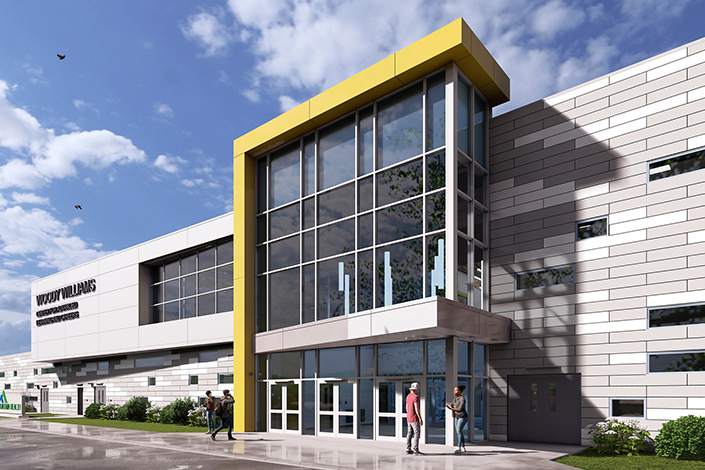
Whether in higher or early education, the spaces where students spend time learning matter. In Cabell County, an abandoned retail space has been transformed into the Woody Williams Center for Advanced Learning and Careers, a workforce development and career readiness hub. Designed by ZMM Architects & Engineers, the center represents a forward-thinking approach to education.
“Every school and school district operates differently,” says Adam Krason, AIA, NCARB, LEED AP, ALEP, CEO, principal and architect at ZMM Architects & Engineers. “There are varying curriculum and curriculum delivery methods and differences in student populations and needs. School districts have varying strategies for integrating technology into their schools and their classrooms.”
Krason says ZMM starts each project by listening. By involving administrators, teachers, parents, specialists, security, maintenance, food service staff and even students in the design process, ZMM provides solutions that reflect each community’s unique vision.
With the Woody Williams Center being built within a repurposed commercial building, it features flexible labs and classrooms designed to evolve with technology and workforce demands.
“Due to rapid technological advancements and changes to curriculum delivery strategies, we place a high priority on delivering schools that provide spaces that are flexible, adaptable and resilient,” says Carly Chapman, ALEP, director of interior design for ZMM. “This flexibility is critical because the technology and methods are advancing so quickly that there are often changes between the completion of design and the completion of construction.” Delivering innovative projects like this requires more than design vision. It also depends on a competitive bid process. Architects and engineers are selected based on their qualifications to design a school. Qualifications often include past performance, proximity to the project, qualifications of the design team and the approach to delivering the project.
“We take our clients’ budgets seriously and ensure that efficient and inspiring building designs are constructed after a competitive bid process,” says David Ferguson, AIA, REFP, COO, architect and principal at ZMM. “This ensures that our clients receive the maximum benefit return on investment, regardless of whether it’s funded publicly or privately.”
Krason says ZMM also utilizes sustainable design features in its projects. This allows the school building itself to act as a learning tool. ZMM has developed materials for the teachers who will be working at the schools to demonstrate how the sustainable design principles that are employed in their school tie into the West Virginia Department of Education Content Standards.
In Greenbrier County, a once-outdated school building has turned over a new leaf. When the county’s existing elementary school, located in a flood zone, reached a point where its infrastructure could no longer operate safely and efficiently, the Greenbrier County Board of Education turned to The Thrasher Group, Inc. for help. Rather than build something new, Thrasher reimagined the town’s former high school into a modern elementary facility.
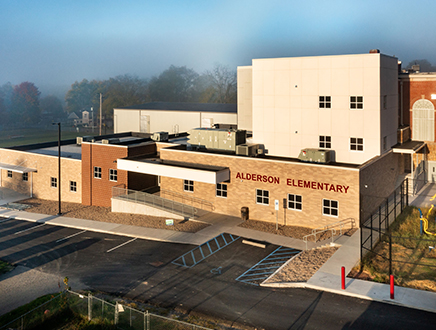
“Every school project begins with a deep understanding of its users—students, teachers and administrators,” says Matthew Breakey, AIA, LEED AP, architect at Thrasher. “We conduct interviews, host feedback sessions and do on-site observations to understand daily flow and pain points. For Alderson Elementary in Greenbrier County, we worked closely with the board of education and community stakeholders to balance educational standards with the practical needs of a modern learning environment. The design was directly informed by those conversations, helping us reimagine an existing structure into something that felt purpose-built from day one.”
Similar to the Woody Williams Center, flexibility was central to this project. Breakout areas encourage independent learning, technology hubs provide access to digital resources and classrooms are adaptable to accommodate evolving teaching methods.
“Moveable furniture and varying room sizes allow the space to evolve over time, keeping pace with new curriculum demands and instructional trends,” Breakey says. “We believe a school should be able to grow with its students, not grow out of its usefulness.”
Thrasher also prioritized sustainability and stewardship when planning the Alderson Elementary project.
“At Alderson, we employed adaptive reuse, repurposing a structurally sound historic building rather than building new,” Breakey says. “That choice not only preserved a
beloved community asset but also reduced material waste and embodied carbon.”
Like Krason says about ZMM’s projects, Breakey says Thrasher views the building itself as a teaching tool, using visible systems and design elements to help students engage with ideas like energy efficiency, history and environmental stewardship.
Breakey also touches on the competitive bid process that goes into school building projects.
“Well-developed construction documents are key as they reduce ambiguity, help control costs and make it easier for contractors to price the work accurately,” he says. “For school projects especially, that attention to detail ensures smoother execution and fewer surprises down the line.”
Like ZMM and Thrasher, the Mills Group recognizes that school buildings must be more than functional. On Davis & Elkins College’s (D&E) campus, the Myles Center for the Arts and Myles Plaza has become a hub for student life, performance and community engagement. The $6.6 million expansion and renovation project was funded by D&E Emerita June Myles and designed by the Mills Group.
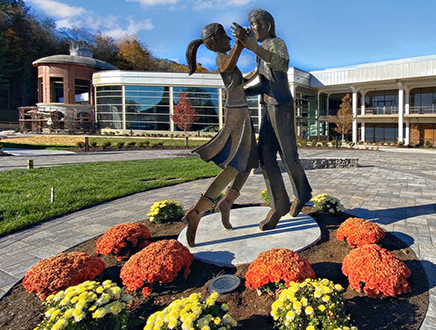
“The Myles Center serves as a major hub of the D&E campus,” says Michael Mills, AIA, managing principal of the Mills Group. “One wing of the complex is the natatorium, and the other is the main auditorium.
The Mills Group aided the college to create a vibrant art department in the lower level consisting of a print shop, ceramic studio, painting studio and digital design classrooms. The design elements were student driven, providing for areas to store personal supplies and display finished works and planning for flexible working environments for the specific media of art.”
Mills says the project focused on transparency, allowing prospective students to see the studios without disrupting classes. This is an important aspect of recruitment and fundraising for the college.
The Mills Group design team most recently reimagined the student forum that connects the pool and auditorium, creating a glass-enclosed addition that nearly doubled its size. The updated space can now accommodate more than 350 people. The addition of an elevator also ensured full ADA accessibility throughout the complex.
Sustainability and flexibility were guiding principles for the Mills Group as well.
“The design needed to be on a single level for it to be a truly flexible space,” Mills says. “We integrated lighting and sound systems to serve groups of multiple sizes and at different times of the day. The furniture matters, too. Having no fixed seating and furniture systems that change and move easily is key. Controls for HVAC and lighting are also important.”
While West Virginia faces ongoing challenges in education, projects like these show how thoughtful design can be a catalyst for change. They shape how students learn and teachers teach and bring communities together to support the next generation.