

By Megan Bevins
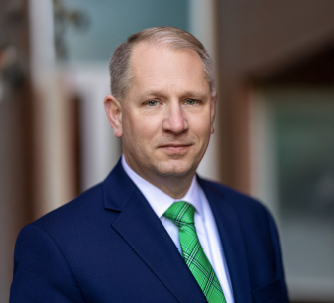
A forerunner of the Mountain State’s health care sector, Larry D. Dial Jr., M.D., possesses a tireless work ethic and deep commitment to service that motivates him in both patient care and leadership.
While obtaining his bachelor’s degree from Marshall University, Dial took part in Dr. Gary Rankin’s pharmacology lab, where he gained an interest in academic medicine. He then earned a Doctor of Medicine from Marshall’s Joan C. Edwards School of Medicine, where he completed his internal medicine residency.
Dial says he chose to practice internal medicine because of the field’s diversity and complexity, allowing him to form meaningful relationships with patients while also engaging with the dynamic range of conditions the field covers.
“This blend of longitudinal connection, acute problem-solving and intellectual depth made internal medicine the specialty where I felt most aligned with my strengths, curiosity and commitment to comprehensive patient care,” Dial says.
Dial currently serves as chief physician executive at Marshall Health Network, a role that tasks him with overseeing care across the system. Here, Dial observes the inpatient services at Cabell Huntington Hospital, St. Mary’s Medical Center and Rivers Health as well as the ambulatory practices of Marshall Health. He also supervises population health initiatives across the region and the network’s pharmacy services.
“My role includes coordinating with all hospitals and academic departments, supporting clinical quality and performance across every care setting and advancing a unified clinical strategy that strengthens patient safety, experience and outcomes,” Dial says.
Early in his career, Dial realized he had a deep love for mentoring future physicians, leading him to seek out roles that would allow him to work with medical students. This ultimately guided him to serving as chief medical officer for Marshall Health and vice dean for clinical affairs at Marshall’s Joan C. Edwards School of Medicine.
Dial says helping medical students become great physicians has been one of the most rewarding aspects of his career.
“Seeing them embrace responsibility, advance in their careers and make meaningful contributions to patient care and the broader community reinforces the lasting impact of mentorship,” he says.
Dial says that while rewarding, balancing the many demands of his career has been a significant challenge. He explains that with the focus required to provide compassionate patient care and the time and commitment needed to support learners, he has had to possess constant discipline, adaptability and prioritization, all while managing the health system.
“This challenge has reinforced my belief that strong clinical care, thoughtful education and dedicated system leadership are all essential and that each is strengthened when patient care remains the guiding priority,” Dial says.
Along with Rankin, Dial lists Dr. Kevin Yingling and Dr. Gretchen Oley as notable mentors. He says while Yingling modeled stellar leadership and sound ethics, Oley greatly influenced his bedside manner.
“Together, their mentorship formed the foundation of my professional identity and the trajectory of my career in medicine,” he says.
Dial has received many accolades, the most meaningful of which is the Gold Humanism in Medicine award he received as a resident in 1999. However, despite his many successes and recognitions, he says his proudest accomplishment is his family: his wife, Sarah; three children, Mason, Kinslee and Kaylyn; and grandchildren, Sophia and Theodore.
Choosing to stay in West Virginia was an easy decision for Dial, who was motivated by his deep love for family and commitment to giving back to the community that shaped him. He continues to live on the family farm where he grew up and says he will always consider the Mountain State home.
“Staying in West Virginia has enabled me to unite my personal priorities with a purpose-driven career focused on service, gratitude and strengthening the health and well-being of the communities I have always called home,” he says.