

By Ava Kaiser
One of the many sectors advancing the Mountain State’s economy is the aviation industry, including advanced air and rural air mobility systems; new technologies in drones, airports, commercial aircraft and more. With the industry rapidly evolving and several new technologies being developed, West Virginia is seizing the opportunity to become a hub for production, education and aviation development.
Education & Workforce
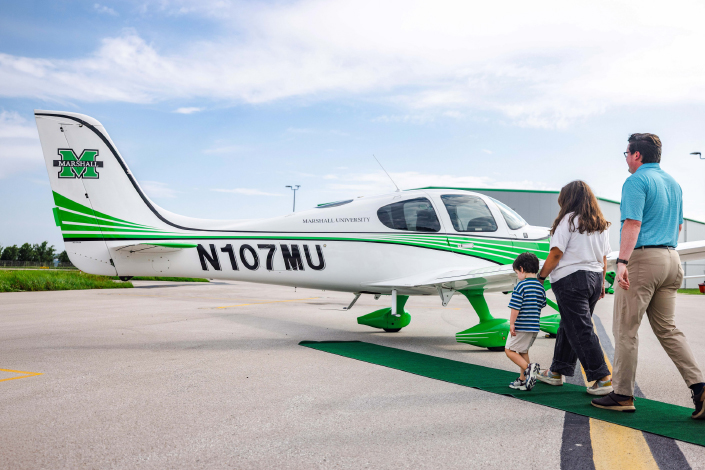
Pierpont Community & Technical College and Marshall University’s Bill Noe Flight School are closing the gap between workforce preparation and industry demand by providing hands-on training, industry connections and real-world learning opportunities to students entering aviation fields.
Bill Noe, chief aviation officer at Marshall University, says the school is preparing students to not only be job-ready but to lead aviation into the future.
“We are preparing students for an industry experiencing historic workforce demand by combining rigorous Federal Aviation Administration training with innovative academic programs, modern simulation technology and meaningful partnerships within the industry,” he says.
To meet aviation industry standards, the curriculum must adapt. Pierpont and Marshall are developing effective learning systems to meet safety and technical requirements for emerging technologies and ensure students learn the in-demand skills for the employers of tomorrow. These programs are integrating electric aircraft, autonomous systems, AI and advanced air mobility (AAM) into the curriculum while maintaining
a strong emphasis on safety and professionalism.
In southwestern West Virginia, Mingo County is home to Mingo One, the first mobile AAM command and control low-altitude airspace management in the state. In efforts to develop a workforce pipeline, the county is in the early stages of introducing AAM-related educational training in local high schools with the help of Mingo One.
“Success here requires building a workforce pipeline almost from the ground up, which is exactly the opportunity Mingo One and the newly developed AAM curriculum were designed to support,” says Greta Curry, executive director of the Mingo County Redevelopment Authority (MCRA).
In September of this year, the Appalachian Drone and Aviation Expo was hosted in Roane County, built specifically to show students the range of career pathways available in the aviation, aerospace and AAM sectors.
Also in Roane County, the WV JumpStart Savings program is being developed to help students access certifications and training to aviation, AAM and drone technology skill sets.
Building programs for industries that are still evolving makes it important for higher education to anticipate industry needs.
“If we are only responding to today’s workforce needs, we’re already behind,” says Brad Smith, president of Marshall University.
By working closely with industry leaders, government partners and employers to identify market needs and industry pain points, students are prepared for jobs that might not exactly exist today.
Essential Partnerships
Continued development in the aviation industry creates a ripple effect, which allows several major industries in the state of West Virginia to benefit, and these sustained partnerships will develop into a lasting demand for the region’s capabilities.
West Virginia International Yeager Airport (CRW) is integrating new technology and infrastructure to support AAM, aerospace and unmanned aircraft systems, positioning itself to become a reliable partner in the aviation industry.
“We’re modernizing and strategically expanding our existing terminal to create a more efficient airport that also enhances the passenger experience and provides a welcoming airport to visitors,” says Dominique Raineri, airport director and CEO of CRW.
Some of the major developments at Yeager include new terminals, airfields and general aviation facilities, as well as electric vertical take-off and landing (eVTOL) aircraft charging stations.
Aviation Innovation and Readiness West Virginia, or AIRWV, a program that prepares students for careers in the aviation industry, was successfully developed by the West Virginia Department of Education with the help of industry partners, including CRW and Marshall University.
“When companies consider where to invest and grow, one of the first questions they ask is whether the workforce exists,” says Smith. “By producing graduates with the skills needed in aviation, aerospace and advanced air mobility, we can answer that question with confidence.”
Lisha Morlan, executive director of Roane County Economic Development Authority, says partnerships have been central in developing Roane County into a natural hub-and-spoke model for AAM and rural air mobility.
“Stephen Connolly, interim commissioner of the West Virginia Division of Multimodal Transportation Facilities, has brought state-level expertise to how Roane County thinks about aviation and AAM together,” she says.
Connolly connected Roane County to ATA Aviation, a direct collaborator for the county’s Rural Healthcare Logistics Innovation Initiative.
“That kind of introduction is exactly what a state partner should be doing for a county like ours,” says Morlan.
The Rural Healthcare Logistics Innovation Initiative pairs Roane and Calhoun counties on ariel medical delivery using unmanned aircraft to deliver medical devices, medications and possibly organs for transplants. As access to emergency medical care is difficult for many citizens of rural communities across the state of West Virginia, partnerships between health care and aviation not only benefit the industry’s leaders, but it also saves lives.
Investments
As projects under the aviation industry umbrella progress, private and public investments are essential to new developments and maintaining current infrastructure.
Mingo One came from a funding award from NASA, leading to site designation and unlocking other development opportunities.
“The MCRA has demonstrated its ability to consistently manage complex federal grants responsibly, facilitating our ability to secure a $2.9 million Congressionally Directed Spending award through NASA, with the assistance of Senator Shelley Moore Capito, and lead us to partner with organizations like Vertx Partners and Azimuth, Inc., on execution,” says Curry.
Although the award from NASA has been a tremendous help, Curry says the MCRA could benefit from private investors from sectors such as manufacturing, logistics and delivery companies to workforce training and development companies
The Economy
As Yeager Airport is seeing an increasing number of travelers seeking more convenient air service and greater nonstop connectivity, Ranieri says investing in these demands can create more opportunities for businesses, passengers and the state.
“As these industries expand, they’re creating new opportunities not only for commercial air service and business aviation but also for workforce development and innovation,” she says. “West Virginia is well-positioned to capitalize on those opportunities through continued investments in airport infrastructure, strategic partnerships and a growing pipeline of aviation talent.”
AAM gives Mingo County and surrounding communities a chance to transform its economy from exclusively relying on the coal industry.
“This isn’t about replacing coal jobs one-for-one. It’s about establishing an entirely new economic sector with its own supply chains, education pipeline and career ladder, rooted in a part of the state that federal and private leaders don’t usually look at,” says Curry.
Aviation in 2036
The future of aviation is promising, and although getting there has its own challenge, with continued investments, strong partnerships and collaborative strategies, the Mountain State can become a major competitor in aviation.
Curry says that in 2036, she hopes to see that current partnerships will have matured into a genuine and regional AAM ecosystem, with private sector operators, defense and public safety users and educational institutions all drawing on the same foundation.
Ranieri says she hopes to see West Virginians supporting their local airports.
“Strong community support creates the demand airlines look for when evaluating new routes and expanding services,” she says.
Smith envisions a state with a strengthened economy, new businesses and life-changing opportunities.
“Ten years from now, I hope people look at Marshall and see a university that helped position West Virginia as a national leader in aviation and AAM,” he says. “Success won’t simply be measured by the number of graduates we produce but by the companies we’ve helped attract, the jobs we’ve created, the research we’ve advanced and the entrepreneurs we’ve inspired.”
Aviation in West Virginia by the Numbers
$849 million Value added to the state GDP from the Aerospace & Defense Industry
Aerospace & Defense Industry supports 5,067 employees
$2.2 Billion total economic impact
For every one job created in aircraft engine and engine parts manufacturing, an additional 0.7 jobs are created through the industry’s spending
Sources:
- AIA Facts & Figures
- IMPLAN 2024 Model Year for West Virginia Region
- S&P Global Market Intelligence
- WV Aerospace Alliance