

By Cathy Bonnstetter
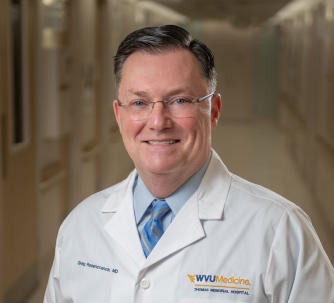
Dr. Greg Rosencrance, M.D., FACP, says his career path has been full of unexpected journeys. In fact, the president and CEO of WVU Medicine Thomas Hospitals, Rosencrance graduated from West Virginia University (WVU) with a degree in chemistry and planned on working in a lab. At one point that plan briefly morphed into a career in dentistry.
Rosencrance received his medical degree from Marshall University. After completing his residency at Charleston Area Medical Center, he stayed for more than two decades working as an internal medicine physician. The Charleston native spent 13 years as chair of the Department of Internal Medicine at WVU’s Charleston campus and as president and CEO of WVU Physicians of Charleston for five years. For 10 years he was the medical director of the West Virginia Poison Control Center.
“I chose the clinical practice of internal medicine because I felt it gave me the most flexibility with my career options,” Rosencrance says. “Mid-career, I pivoted to administrative leadership.”
The move from clinical practice to administration sent Rosencrance out of the Mountain State. He served as the chairman of medicine and medicine subspecialities for the Cleveland Clinic in Florida and then system chair of the Medicine Institute for the Cleveland Clinic in Cleveland, Ohio.
After that, it was back to Florida to become president of the Cleveland Clinic Indian River Hospital where he led more than 2,500 caregivers throughout the hospital and its 11 community-based centers. As his family prepared to return to Florida, Rosencrance’s two sons asked him how a hospital president spends his days.
“I told them a hospital president does three things: they create a culture; they set a vision for where the hospital is headed; and they find the resources to make it happen,” Rosencrance says. “My favorite part of the job is interacting with the caregivers, patients, physicians and community leaders to help provide excellent health care close to home and help strengthen our communities.”
Along with his parents and family, Rosencrance credits Dr. Warren Point, Dr. Bert Bradford, Dr. Shawn Chillag, Dr. David Longworth and Dr. Al Pfister with influencing his career and helping him understand and navigate leadership, clinical care and the community.
Rosencrance returned to West Virginia in 2023 to take the reins at WVU Medicine Thomas Hospitals.
“When I was living out of state and someone said to me, ‘I am coming to your state next week,’ I would think, ‘I wonder why he’s coming to West Virginia,’” he says. “The resilience, work ethic and drive I learned in my home state has contributed immensely to any success I have had.”
In his current role, Rosencrance is focusing on further developing and strengthening the hospital’s signature service lines and providing patients services close to home. His volunteer work includes the West Virginia Symphony Orchestra Board of Directors, Maier Foundation Board of Directors and The South Charleston Economic Development Authority.
Rosencrance says his most important accomplishments do not come with awards.
“My greatest success is my family—my wife, children and the life we have built and now my grandchildren” he says. “Professionally, my greatest successes are each life I have touched and hopefully made better in some small or large way. Scaling that across our community is a legacy and a success measure for me.”