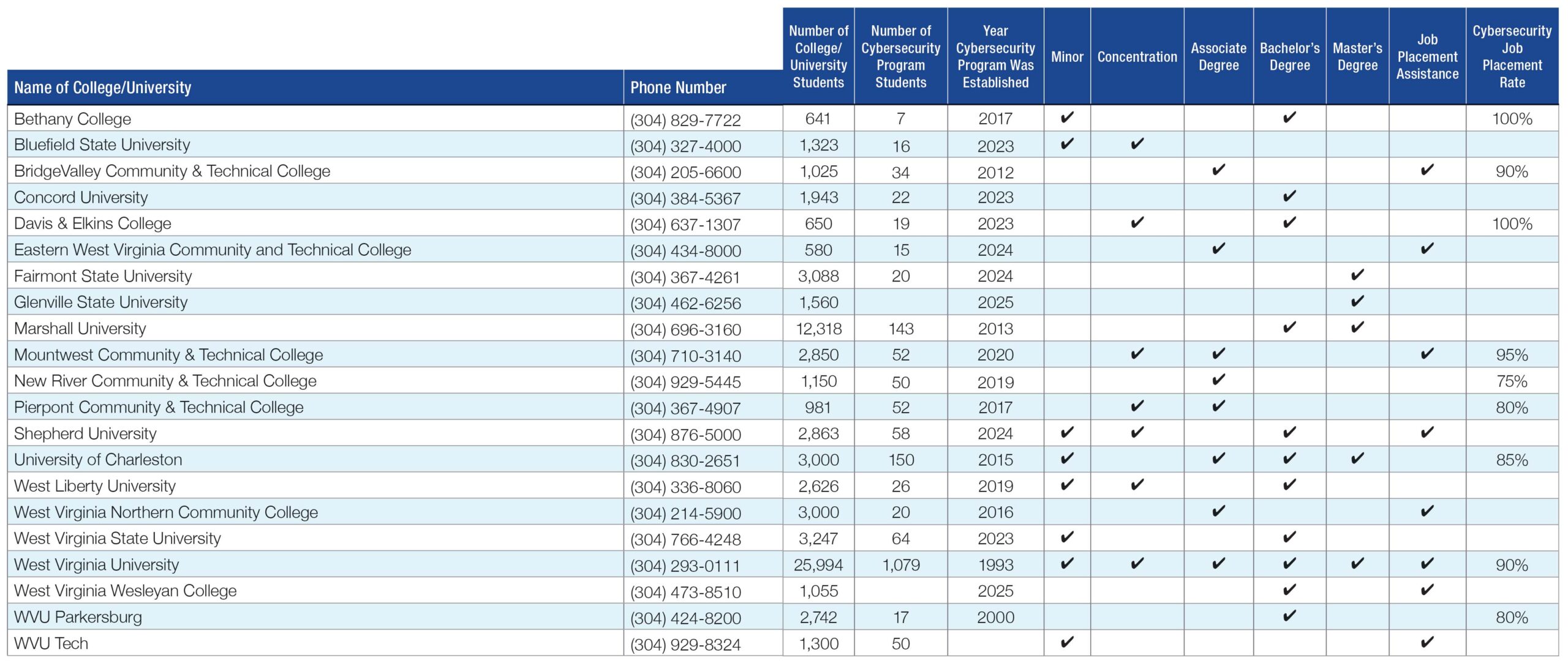



Higher education institutions across West Virginia are stepping up to meet the growing demand for cybersecurity and technology professionals. Colleges and universities throughout the state are expanding programs, building industry partnerships and providing hands-on training to prepare students for careers in this critical field. Students are learning not just the technical skills of cybersecurity but also the ethical standards, practical experience and adaptability needed to protect infrastructure, businesses and communities.
Concord University
Concord University’s cybersecurity program stands out through its focus on secure software development, hands-on experiences and a student-centered environment.
“Unlike other state institutions’ programs, Concord’s emphasizes secure coding, reverse engineering and system hardening,” says Lonnie Bowe, assistant professor in computer science at Concord University. “These skills are in high demand across government and industry. A robust computer science foundation ensures students graduate with both theoretical and practical expertise.”
Launched as a Bachelor of Science degree in 2023, the program grew from a concentration within computer science, driven by rising student interest and workforce needs. Faculty shaped the curriculum using standards from the National Security Agency and Association for Computing Machinery to ensure alignment with industry expectations.
“This reflects a commitment to keeping the curriculum relevant while addressing the cybersecurity talent gap in Appalachia,” Bowe says.
The program is also unique in serving Southern West Virginia, offering a full four-year degree in cybersecurity to students who may not have access to larger institutions. Its location and structure make it an accessible and affordable option for first-generation and place-bound students.
Concord’s small-campus atmosphere offers cybersecurity students deep mentorship and personalized guidance. With class sizes of 15 to 20 students, faculty can tailor instruction and help students build both technical expertise and professional capabilities.
Fairmont State University
Fairmont State University is preparing students to tackle complex cybersecurity challenges through an approach that blends advanced coursework, artificial intelligence (AI) applications and close industry partnerships.
At the undergraduate level, students build a foundation through data analytics and business intelligence courses that provide in-depth instruction on AI, machine learning and deep learning.
“These foundational skills are then applied in the Master of Science in Cybersecurity & Risk Management program, where students leverage AI and machine learning techniques to enhance cyber threat intelligence,” says Robert G. Cutlip, Ph.D., director of Master of Science in Cybersecurity & Risk Management, Graduate Studies and Cybersecurity and Data Analytics programs, College of Business & Aviation at Fairmont State.
Graduate-level coursework incorporates these skills into real-world cybersecurity applications, including anomaly detection, phishing identification, natural language processing and neural network modeling.
“This integrated approach prepares students to use cutting-edge technologies to identify and mitigate evolving cyber threats,” says Cutlip.
Fairmont State stays current with the evolving cybersecurity landscape through guidance from its Industry Advisory Board, which includes professionals from private industry, state and federal government as well as national laboratories. Additionally, the master’s program integrates real-world experience through a mandatory, two-semester, hands-on project.
“Students collaborate with an industry sponsor to gather requirements and develop a formal project management plan,” Cutlip says. “Students present their final deliverables to the course instructor, project sponsor and key stakeholders at the end of the spring term.”
Fairmont State students are also involved in a federally funded critical infrastructure analysis initiative. This U.S. Senate-directed program gives students the opportunity to use their skills working collaboratively with the Department of Defense, Department of Energy National Laboratories and Azimuth, Inc.
Mountwest Community & Technical College
Mountwest Community & Technical College prepares students for cybersecurity careers through a mix of classroom instruction, lab work and close partnerships with local industry leaders. The program offers classes focused on both the Microsoft and Cisco sides of network cybersecurity.
“On the Microsoft side, students create and configure domains, virtual machines and Microsoft Exchange environments on real machines in the classroom and in Azure,” says Associate Professor of Information Technology Patrick Smith. “On the Cisco side, students utilize Packet Tracer to do simulated network layouts and configurations and are able to save those configurations to load on the hands-on equipment used in the classroom.”
Many of these classes culminate with hands-on final exams, bringing together the individual course assignments into singular comprehensive projects. Students benefit from Mountwest’s collaboration with industry partners, including Ntiva, a leading managed service provider co-located on campus.
“A student can finish a class and walk a few steps down the hall to a job where they can put the concepts they just learned to the test by helping actual clients with real-world problems,” Smith says.
Graduates typically pursue careers in network operations, system administration, help desk support or security operations roles, with many advancing to positions on network or security teams.
The Center for Cybersecurity at Mountwest has enhanced the college’s offerings in multiple ways.
“It helped us obtain a designation as a Center of Academic Excellence in Cyber Defense, allowing us to show the public that the curriculum and training at our institution has been vetted and is of high quality,” Smith says. “It also creates a space for a cyber range, creating additional hands-on experience opportunities for our students, and allows potential students and the community to come and learn about cybersecurity and how to protect themselves from scammers and hackers.”
In these courses, students are taught to work from a foundation of moral principles and standards.
“We try to instill in our students that just as confidentiality cannot be recovered once exposed, acting amorally as a cybersecurity expert will tarnish a promising career and leave a lasting mark that will haunt them throughout their future,” Smith says.
West Virginia State University
At West Virginia State University (WVSU), students gain real-world cybersecurity experience while helping protect the state’s small businesses, schools, hospitals and critical infrastructure through the university’s new cybersecurity clinic, funded by a $1 million grant from Google.
“The WVSU Cybersecurity Clinic’s primary mission is to develop a skilled, diverse and ethically grounded cybersecurity workforce through real-world, service-oriented training,” says Dr. Ali Al-Sinayyid, director of the Google Cybersecurity Clinic and Cyber Security Innovation Center and assistant professor of computer science at WVSU. “Our clinic bridges the gap between academic learning and professional readiness by enabling students to provide cybersecurity support to underserved local entities.”
At the clinic, students complete hands-on projects, including penetration testing, security awareness training and policy development, all supervised by faculty and Google mentors.
“Currently, there are nearly 450,000 cybersecurity jobs available in the U.S., and demand for cyber professionals is projected to grow 32% by 2033,” Al-Sinayyid says. “By offering practical, community-embedded experiences, we are preparing students to step directly into high-demand roles with tangible impact.”
The clinic integrates AI tools for threat detection, anomaly analysis and automated response simulations. Students also train in the CyberHive lab, housed in WVSU’s Cybersecurity Innovation Center, which replicates industrial control systems and integrates AI-based monitoring.
Al-Sinayyid says AI is both a complement and a catalyst for transformation in the cybersecurity field.
“Our goal is to cultivate adaptive thinkers who can collaborate with AI, not compete against it,” he says.