

Shortly after Brad Smith was named president of Marshall University, a strategic roadmap for future prosperity was brought to life.
“Marshall For All, Marshall Forever is underpinned by delivering an in-demand curriculum, available on-demand, with six interdisciplinary pillars where Marshall is distinctive,” Smith says. One of these pillars is advanced manufacturing, so rebranding the Robert C. Byrd Institute to Marshall Advanced Manufacturing Center (MAMC) when the strategic plan was announced made sense.
“The rebrand to MAMC better reflects the center’s role in advanced manufacturing technology, workforce training and industry support,” Smith says. “In doing so, it has heightened awareness of MAMC’s capabilities while illustrating the evolving landscape of higher education.”
Part of the growth plan for MAMC is to scale its impact by 10 times more than what it is currently over the next decade. This will be accomplished through collaborative approaches such as Marshall Inside, in partnership with career and technical education as well as community and technical college partners across the state. To ensure this happens, Smith brought on Brandon Dennison, vice president of economic and workforce development for Marshall University.
“I met Brandon in his role as founder and CEO of Coalfield Development and was immediately impressed with his leadership skills,” he says. “His commitment to workforce training, deep understanding of West Virginia and the broader Appalachian culture as well as his track record of success developing innovative economic development programs and building coalitions to advance our state, were second to none.”
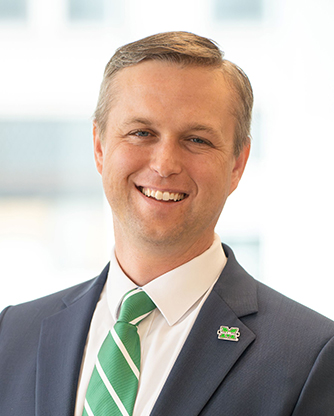
Dennison is glad to bring lessons learned at Coalfield Development into his work at Marshall.
“I still serve as the executive president of Coalfield Development’s board, which enables me to help shape its strategy and vision,” he says. “Both organizations share the goal of increasing workforce participation in our state. They are willing to do whatever it takes to serve learners of all kinds and help unlock their full potential.”
MAMC is just one example of the incredible work happening every day at Marshall as it embraces its role as an economic engine for the region.
“When President Smith started, we had an economic return on investment of 1:12 back to the State of West Virginia, meaning for every $1 the state invested in us, we generated an additional $12 in economic activity,” Dennison says. “Today, this figure is 1:18, meaning we now generate $18 in economic activity for every $1 the state invests in us. This all adds up to more than $1.1 billion in economic activity annually.”
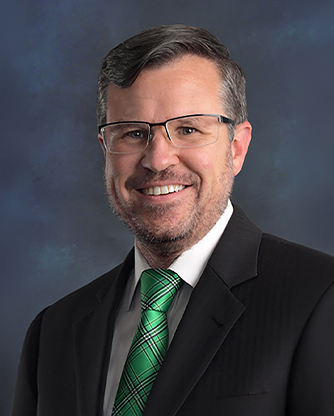
Hardly a day passes that Director of MAMC Derek Scarbro and his team don’t field calls from West Virginia manufacturers seeking to hire MAMC students.
“The drumbeat is constant,” Scarbro says. “There’s a demand for machinists, welders, industrial maintenance technicians and related positions, and companies know we deliver an industry-focused education.”
In fact, the need for skilled workers is so great that more than 95% of MAMC’s career-skills students find jobs in their chosen fields, many before they graduate. To better understand the scope of that need, MAMC commissioned the Marshall University Center for Business and Economic Research (CBER) to conduct a statewide survey of manufacturing workforce needs.
West Virginia manufacturers anticipate the need for 2,700 full-time workers over the next 12 months and nearly 7,000 over the next three years. Employers expect to hire across a range of manufacturing occupations, including 2,721 production positions and operators, 779 laborers and logistics experts, 496 welders, 541 machinists, 696 maintenance technicians and 595 workers in quality assurance and testing.
“Manufacturers nationwide report 380,000 job openings, and West Virginia is facing the same challenge,” says Bill Bissett, president of West Virginia Manufacturers Association. “It is imperative we attract more people of all ages to our workforce. The good-paying jobs available here provide an opportunity for more people to pursue rewarding careers in the Mountain State.”
Dennison says the university is working in tandem with industries to meet current workforce needs and ensure the skilled laborers of tomorrow.
“This demand for employment from plants and factories across our region is one of the many reasons Marshall has identified advanced manufacturing as a primary pillar of excellence,” he says. “Through job training, business support and applied research, we are building the manufacturing sector of the future.”
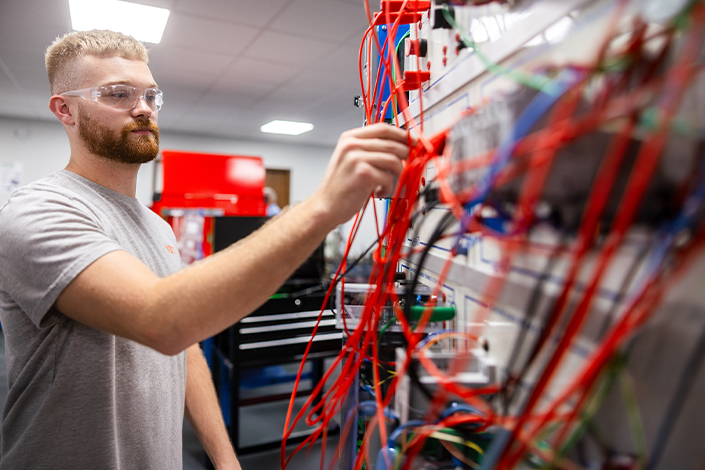
When it comes to manufacturing, MAMC spearheads the university’s workforce efforts. Deploying what Scarbro describes as a 360-approach, MAMC assesses industry employment needs, develops training solutions to meet those needs, recruits students into high-demand fields and delivers industry-focused career-skills training solutions that lead to good-paying jobs.
In addition to formal surveys, MAMC’s outreach team visits businesses throughout the state, meeting directly with employees on factory floors to better understand workforce challenges and provide solutions. The center also engages with representatives from more than 360 companies each year that use advanced technology at its Huntington and South Charleston facilities.
MAMC’s nationally recognized career-skills programs are guided by a workforce advisory board comprised of manufacturing professionals.
“These survey numbers validate what we regularly hear from manufacturers,” Scarbro says. “That’s why we’ve expanded, and will continue to expand, to solve the workforce needs on multiple fronts. We can do this through student certificate and associate degree pathways and short-term, company-specific training as well as apprenticeship and pre-apprenticeship partnerships.”
MAMC partners with Mountwest Community and Technical College to offer its Machinist Technology/CNC program in Huntington and expanded the program to South Charleston in 2024 in partnership with BridgeValley Community and Technical College. The program currently offers welding technology that will double in capacity in fall 2026 with the opening of the new advanced welding and robotics technology training centers on the site of the former ACF Industries in Huntington.
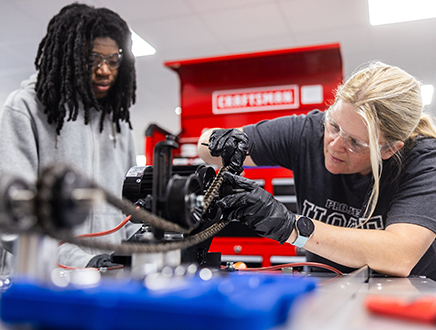
To meet growing demand for industrial maintenance technicians, MAMC partnered in 2024 with more than two dozen manufacturers and Mountwest to launch a new career skills program: Systems Maintenance, Automation and Robotics Technology (SMART). Classes are offered in Huntington and Point Pleasant. Within weeks of the program’s launch, Nucor West Virginia and Toyota West Virginia hired SMART students as paid interns, with some now entering the state’s workforce as full-time employees.
“Workforce development and strong education programs are essential for our region,” says David Rosier, president of Toyota West Virginia. “When we invest in students and create clear pathways to high-quality careers, we support manufacturers and employers across the region. Most importantly, these partnerships uplift our communities by opening doors, expanding opportunity and empowering the next generation to thrive right here at home.”
Meanwhile, MAMC operates Apprenticeship Works, the National Advanced Manufacturing Apprenticeship Partnership, which helps companies upskill current workers and train new employees. MAMC has assisted companies in 26 states, including 39 manufacturing operations in West Virginia, with implementation of U.S. Department of Labor (DOL)-registered apprentices in 20 high-demand occupations.
Last year, MAMC forged a partnership with the West Virginia Department of Education to develop a pre-apprenticeship program for state career and technical education students that creates pathways into DOL-registered apprenticeships and long-term employment. MAMC mapped the skills taught in high school programs to national registered apprentice standards so more than 2,000 students can receive early credit toward full apprenticeships while creating a direct pipeline of talent for regional manufacturers.
“Manufacturing is an indispensable driver in our state’s economy,” says Kent Sowards, director of CBER. “It provides stable, high-quality jobs but also fuels innovation and technological growth.”