


The Mountain State, with its abundance of natural resources, has the ability to become a major power supplier. In recent years, policymakers and energy companies in the state have begun working to find new ways to generate more power and stabilize current energy production to push West Virginia further toward this goal.
In 2025, Governor Patrick Morrisey announced the 50 by 50 energy plan, a move to increase the state’s energy capacity from 15 gigawatts to 50 gigawatts by 2050. As part of this initiative, West Virginia will begin following an all-of-the-above approach to energy. This means instead of prioritizing one energy source, the state will use every appropriate means of generation available to fuel its power needs.
Nicholas Preservati, deputy secretary for West Virginia Department of Commerce and director of the West Virginia Office of Energy, says since not every source of generation is fit for energy production in West Virginia, the all-of-the-above approach will embrace all resources that are economically viable.
“Each state should be able to choose the energy sources that work best for them,” Preservati says. “In West Virginia, we see nuclear playing a pivotal role in the future and that West Virginia’s baseload generation will be complemented by renewables where available.”
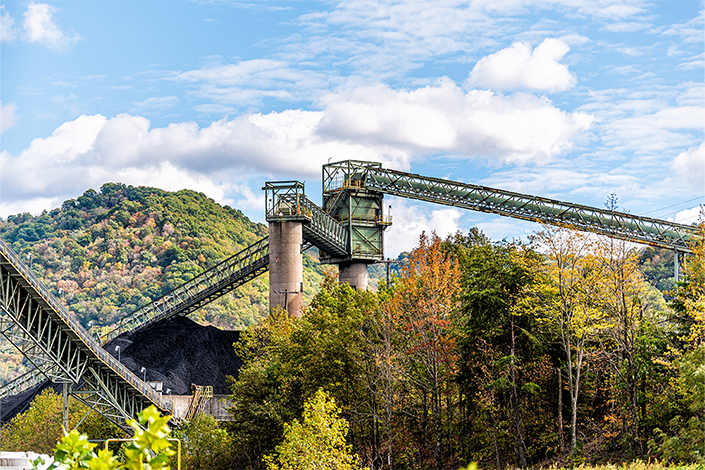
While this approach will make use of the state’s multiple energy assets, Chris Hamilton, president and CEO of the West Virginia Coal Association, emphasizes the importance of West Virginia’s most notable resource: coal. Hamilton explains that coal-based power generation was once responsible for America’s economic dominance and believes it should still be utilized today.
“West Virginia runs on nearly 90% coal-based power, and that gets us some of the most secure and affordable electricity in the country,” he says. “The most coal-dependent state in America also happens to be one of the best-positioned states when a cold snap hits or demand spikes. That’s not a coincidence.”
The West Virginia Coal Association has shifted its focus to modernizing the coal-fired power plants currently
operating in West Virginia.
“Comparing modernization to new generation buildout at today’s capital costs isn’t even a fair fight,” Hamilton says, “So for us at the association, the plan sharpened the focus considerably. The 50 by 50 plan gave that work a deadline and the sense of purpose it needed.”
Last year, Morrisey also announced a $1.44 billion investment in refurbishing coal-fired power plants, allowing for significant upgrades and the possibility to expand West Virginia’s dispatchable generation capacity without the high cost of a new buildout. Additionally, the Pleasants Power Station in Pleasants County, which has been operating at reduced capacity, is working toward full power generation again.
Frontieras North America is also in the process of building an advanced carbon technology facility in the state, using coal to help manufacture commercial products.
“Put it all together and the picture is clear: West Virginia isn’t managing a decline in coal, we’re modernizing it, diversifying its applications and positioning it to continue being the foundation of the state’s energy economic future,” Hamilton says.
West Virginia is part of Pennsylvania-New Jersey-Maryland (PJM) Interconnection, a regional transmission organization that supplies and manages power to 13 states and Washington, D.C. With its abundance of resources, the Mountain State can both meet its own needs and export power to other areas in the PJM.
Currently, the state’s generating capacity sits at approximately 14,000 megawatts. Of this, 12,500 come from coal-fired resources while around 1,000 are from natural gas. Asim Haque, senior vice president for PJM Interconnection, says each resource is assigned a value according to how it performs during tight system conditions. If the resource can contribute high capacity during these times, it is given a higher value than a resource performing at that same capacity during low-risk hours. Coal’s value currently sits at around 85%.
“As generators retire and more intermittent energy resources come online, we are in need of more dispatchable generation,” Haque says. “Traditionally, this has been a role filled by coal, natural gas and nuclear resources.”
Despite the state’s reliable power, the demand for data centers and other large loads that require mass amounts of energy is surpassing the available power in the grid, creating a need for more energy infrastructure. Haque says PJM is working on maintaining grid reliability and affordability for consumers as data centers begin to integrate into the system.
One way to balance data centers and grid reliability is through co-location, or placing the data center next to a generator it can then offtake power from. A ruling from the Federal Energy Regulatory Commission has allowed these arrangements to take place, meaning there will likely be more of them moving forward.
Haque says expanding electric and gas transmission systems in the state is the biggest factor in maintaining its status as a regional energy supplier in the PJM. This means building more pipelines and generating more electric transmission to meet in-state needs and be able to export power elsewhere.
Echoing this sentiment, Rebecca McPhail, president-elect of Gas and Oil Association of West Virginia, explains that the state not only needs investment into energy and site-readiness infrastructure but also must strengthen its natural gas infrastructure to support economic growth and grid reliability.
“Beyond energy infrastructure, industrial growth also depends on site-ready assets such as water and wastewater capacity, transportation access and prepared industrial sites that allow projects to move quickly from concept to construction,” McPhail says.
Though West Virginia already has a strong foundation in terms of natural gas pipelines and transmission systems, last-mile pipeline materials and capacity upgrades will be essential to targeted additions that will connect these existing pipeline systems to new power generation facilities, industrial parks and data centers. McPhail adds that additional natural-gas fired power plants would also allow West Virginians to enjoy the state’s natural gas at the same time it is exported.
As large projects require a reliable gas supply and fuel availability, limits on gas pipelines sometimes deter them from taking place. However, with its natural gas reserves, the state can meet these requirements.
“Additionally, companies will be more likely to build in West Virginia if our state leaders prioritize transparent policies that support these projects,” McPhail says. “We need a positive business and regulatory environment with the infrastructure to back it up.”
With the implementation of the 50 by 50 plan, it is clear the state intends to position itself as a leader in the energy sector. McPhail says this, along with developments that encourage the increase of natural gas, will bring investments to the state’s economy and communities.
 “By setting an ambitious target for expanded in-state generation, the plan helps align policymakers and energy producers around a common goal: using our state’s abundant natural resources to be an energy leader for decades to come,” she says. “Today, that means focusing on regulatory certainty, infrastructure readiness and policies that encourage private investment in generation and large-load industries while maintaining reliability and affordability for consumers.”