

West Virginia’s Attorney General
By Samantha Cart
Oftentimes as American citizens and voters, we get caught up in the fervor and fanfare national elections illicit while neglecting the meaningful and significant impact local and state elections have on our daily lives. There are 148 state-level elected officials in West Virginia among its executive branch, legislature and congressional representatives, and that number does not include the thousands of local officials across the state’s 55 counties.
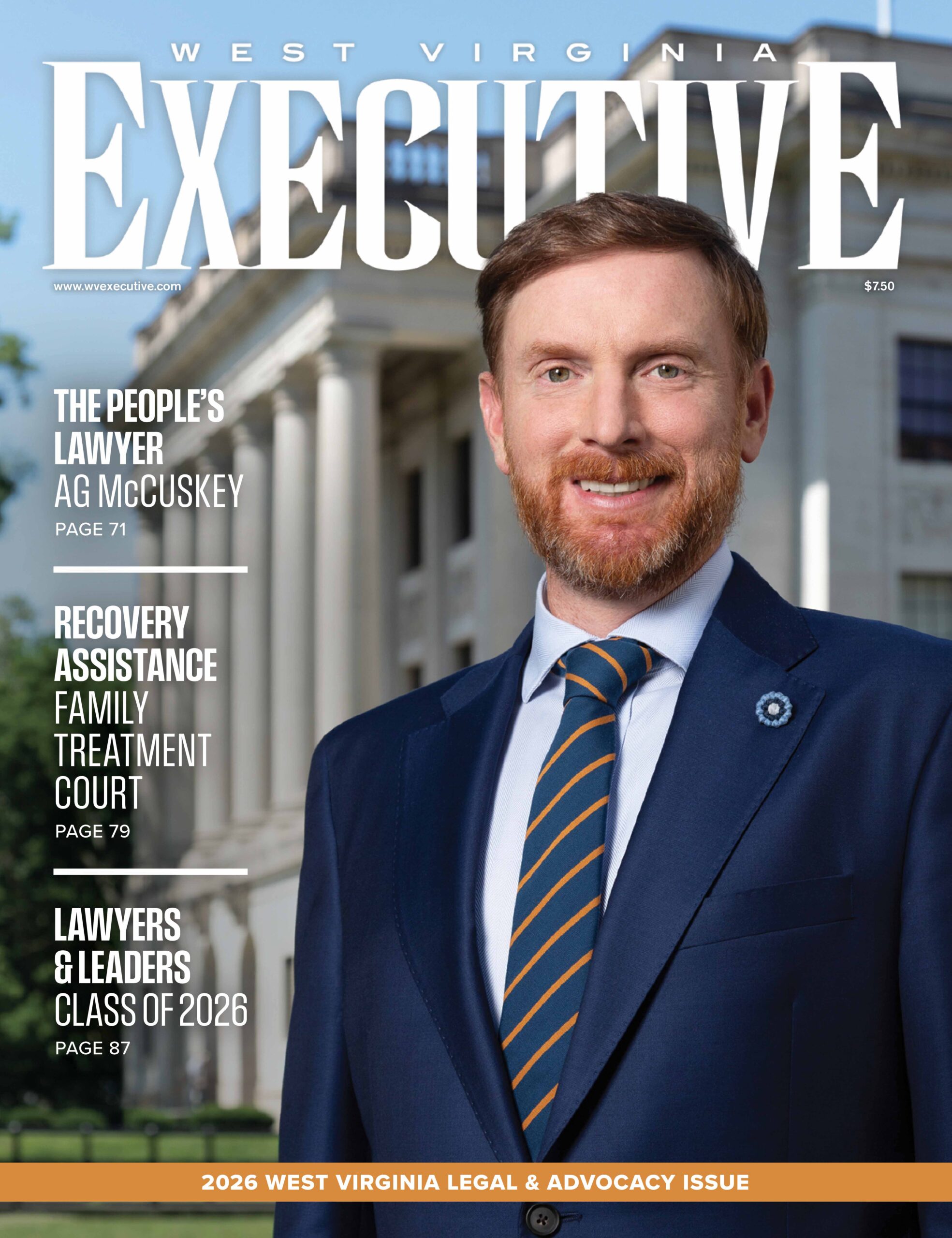
Among the state’s executive branch is the attorney general, who serves as the chief legal officer for West Virginia. Sometimes referred to as The People’s Lawyer, the attorney general represents the state in both state and federal court, provides legal counsel to government agencies, offers written opinions addressing questions of law, advocates for the rights of West Virginia’s citizens and enforces and defends laws pertaining to consumer protection, unfair trade practices and civil rights, among others.
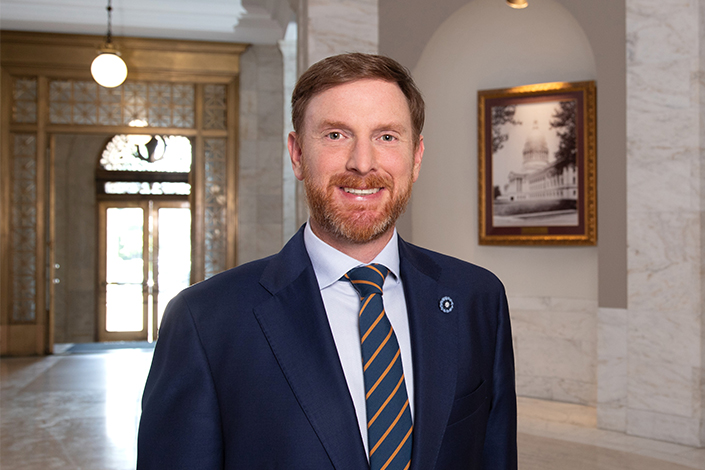
In 2025, JB McCuskey was sworn in as the state’s 35th attorney general.
A strong educational and professional background coupled with a history of service laid a strong foundation for his eventual role as attorney general. A native of Harrison County, WV, McCuskey holds a bachelor’s degree in political communication from George Washington University and a Juris Doctorate from West Virginia University College of Law.
After undergrad, he worked as a civilian for the U.S. Department of Defense at the Pentagon in the offices of the Army and Department of Defense general counsels and for the American Center for Law and Justice.
“It was an incredible experience to work in D.C. as a public servant,” McCuskey says. “Those experiences broadened my world view, but I always knew I wanted to come home to serve in some capacity, whether that be through my legal career or in public service.”
After graduating from law school, McCuskey worked in the oil and gas space, which provided him with a clear understanding of the important work happening in West Virginia and the challenges these industries face.
He took the plunge into public service by running for the West Virginia House of Delegates, where he was elected to represent District 35 in Kanawha County from 2012 to 2016. He then served as state auditor from 2017 to 2025, where he worked toward the goal of making West Virginia the most transparent state in the nation.
While each of these experiences helped prepare McCuskey for his role as attorney general, he says nothing impacts and motivates him more than being a father.
“I understand the challenges families and kids face, and I work every day to make their lives better,” he says.
In just a year and a half, McCuskey’s office has taken on titans of a variety of industries. When looking at the work on a national scale, deciding which legal battles are worth West Virginia’s time and resources can be a daunting task.
“As an office, our role is to defend the state of West Virginia in a myriad of ways, so many of our cases are supporting the actions of the Legislature and the governor,” McCuskey explains. “We also have a robust appellate division handling criminal appeals before the Supreme Court. However, we have been incredibly aggressive in going after businesses that are harming our state, our people and our kids.”
While Mountain State citizens may feel disconnected from court cases being played at this scale, the lives of West Virginians can be profoundly impacted by their outcomes.
In terms of economic growth, the attorney general’s office plays a vital role on the national level when it comes to energy policy. McCuskey and his team currently have two lawsuits fighting superfund laws in New York and Vermont, which could potentially bankrupt energy producers nationwide.
These laws mirror the Superfund Act—also known as the Comprehensive Environmental Response, Compensation and Liability Act—a federal law enacted in 1980 that provided the U.S. Environmental Protection Agency (EPA) with additional authority and funds.
“The superfund acts in New York and Vermont impose billions of dollars in fines to energy producers for past energy production—which, mind you, was produced according to regulations at the time,” McCuskey explains. “The states are claiming climate change, but it’s really just a money grab to balance their budgets. We are confident in our efforts to find these laws unconstitutional, preventing other states from following suit.”
McCuskey is also taking the lead on a multistate effort to restrict the federal scope of the Clean Water Act by limiting federal jurisdiction and overreach that imposes burdensome regulations on farms, private property development and local infrastructure projects.
“Our office is currently leading the way as the EPA begins to restore the Clean Water Act to its true intention,” McCuskey says. “These new policies will instill confidence in industries that were stifled by overregulation, and we anticipate new power plants will finally be built to meet the growing energy needs of this nation.”
It is his hope that these actions in the energy space will drive down energy costs and ultimately the cost of living for West Virginians.
McCuskey is also concerned about the health and well-being of Mountain State residents, which is why he has prioritized fighting to provide access to 340B drug discounts for all West Virginians and continuing the legal battle against companies at the epicenter of the opioid epidemic by going after pharmacy benefit managers for their role.
McCuskey is also passionate about child internet safety and other emerging online threats, such as artificial intelligence (AI).
“The emergence of AI is the greatest threat to consumers,” he says. “We have received complaints in our office of scammers using deep fakes and voice cloning to try to trick people. It is scary stuff and makes it even harder to know what can be trusted and what cannot. We are actively fighting back against these scams and encourage consumers to report all scams to our consumer protection division. We also encourage you to verify claims through trusted sources and remain skeptical.”
McCuskey’s office has filed a lawsuit against Apple for its role in allowing child sexual abuse material to be stored and shared and recently reached an $11 million settlement with Roblox, prompting new safety features to be added to the popular online kids’ game.
“I have two young daughters who love Roblox, so I know how popular it is, but our investigation found serious failures that left children exposed to real danger,” he says. “The investigation found that Roblox’s historical safety design allowed child users to be exposed to sexual predators, grooming and sexual and violent content, putting every child on the platform at risk. We could not allow that to happen and had to act through legal action against the company. Bringing the issues to light has prompted real change within the game. Roblox has agreed to verify the age of all users before granting chat access, block all chat until age verification is complete, restrict adults from contacting users under 16, alert minors the first time they enter a private chat and block adult-rated material proactively. In additionto those in-game safety changes, the company has also agreed to dedicate a West Virginia-based internet safety specialist to coordinate directly with state law enforcement and conduct training with law enforcement, schools, parents and kids. The company also agreed to pay the state $11,080,000 in damages.”
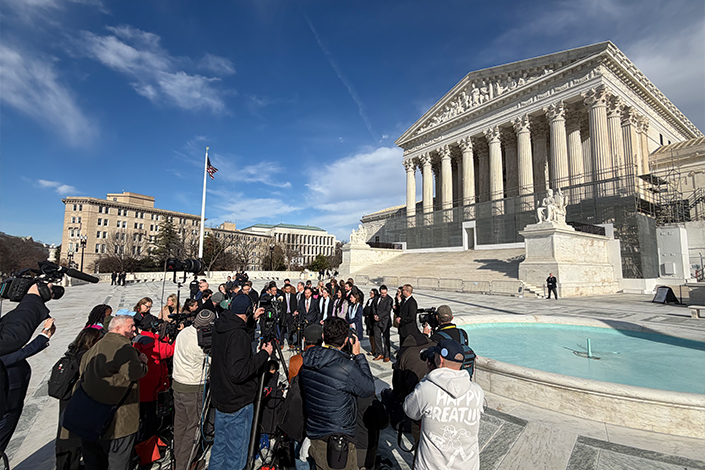
Of all this formidable work, there is one case from his tenure McCuskey believes will have a truly lasting impact on the Mountain State. In January, his office, led by Solicitor General Michael Williams, argued West Virginia v. BPJ before the U.S. Supreme Court in an effort to defend West Virginia’s Save Women’s Sports Act. Also known as House Bill 3293, this 2021 law prohibits transgender females from competing on female sports teams and mandates that school-sanctioned athletic events are based strictly on biological sex at birth. On June 30, the Supreme Court voted to uphold the act.
“This is a monumental victory for every female athlete who has ever competed, or dreamed of competing, on a fair and safe playing field. This Supreme Court decision affirms what common sense and the law have long made clear: states have the right to designate sports teams based on biological sex, not gender identity,” McCuskey says. “Without that delineation, Title IX is turned on its head, and decades of hard-fought progress to advance female athletes are erased. I am immensely proud of my team for not only getting this issue before the court but also for delivering sound and successful arguments. This landmark victory will give all states, not just West Virginia, the clarity and confidence to ensure fairness and safety for female athletes today and for generations to come.”