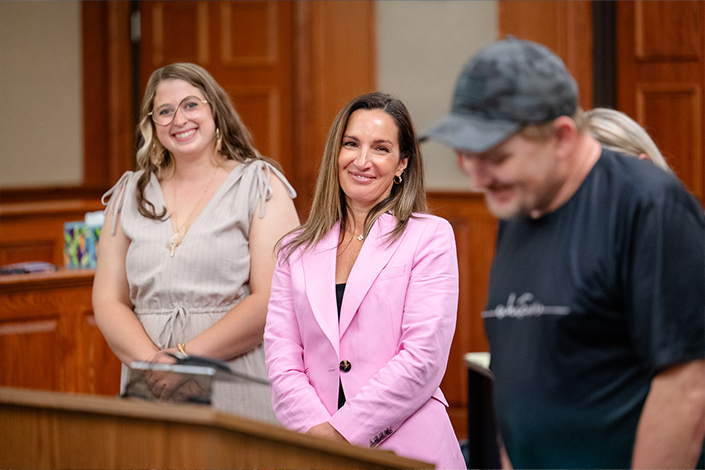


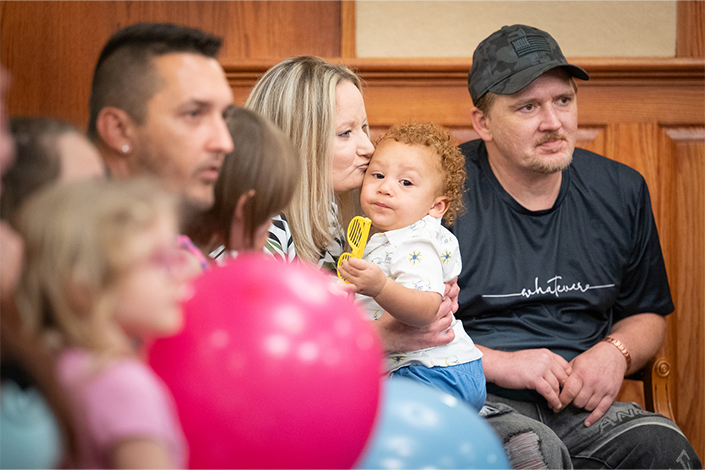
Family Treatment Court (FTC) is a specialized court that focuses on long-term recovery for parents who are involved in the child welfare system. The main goal of this court is to allow the parents to receive the help they need while safely and permanently reunifying them with their children.
Unlike a traditional court process designed to resolve legal disputes, FTCs use a collaborative approach that offers a multidisciplinary team that works directly with the families to support their recovery and monitor their progress.
“Participants appear before the court regularly, engage in treatment, work closely with recovery professionals and are held accountable every step of the way,” says Tera Salango, Eighth Judicial Circuit judge.
These specialized courts were facilitated by William Thompson, dean of students at the Appalachian School of Law and counsel at Spilman, Thomas & Battle PLLC, who drew inspiration during an orientation in Reno, NV, as a newly appointed judge in 2007.
“Part of the training included attending a local drug court. I knew West Virginia, at the time, had a few drug courts in operation, and I thought bringing one to Boone and Lincoln counties could really benefit the people there,” says Thompson. “When the Supreme Court later asked circuit judges if they would be interested in starting one, I volunteered quickly.”
FTC serves many parents who have been involved in abuse and neglect cases where substance use disorder (SUD) contributed to the circumstances that brought their family into the child welfare system.
“In a lot of these cases, addiction is the underlying issue that impacts a parent’s ability to safely care for their children,” says Salango. “The goal is to address that issue while focusing on child safety, family stability and long-term recovery.”
There are three different ways a parent can be referred to FTC: a one-page referral form, case coordinator referral or circuit judge referral from the bench. After FTC receives a parent referral, the case coordinator contacts the parent to schedule an interview and a time to do the screening to determine if they meet the criteria of SUD.
“Family Treatment Court is voluntary in West Virginia, meaning every participant must consent to participate,” says State Family Treatment Court Specialist Katie White.
“When the parent’s substance use disorder determination has been made, the case coordinator will staff the referral with the FTC treatment team, which is a group of professionals and community members who handle the day-to-day operations of Family Treatment Court and work closely with the participants and their
families,” says White.
After reviewing the case, the FTC judge will make an acceptance decision based on whether the parent meets the eligibility and participation criteria.
“Family Treatment Court focuses specifically on the intersection of substance use disorder, child welfare and family reunification,” says Salango. “That focus allows us to bring together professionals from multiple disciplines to address the root causes contributing to abuse and neglect cases, ultimately decreasing the workload and burden on the already overloaded judicial system.”
The participants in FTC reside in different places according to their individual needs as parents. They can stay in their homes while receiving their outpatient treatment, sober-living residences or short-term residential treatment.
Funding for FTC has not been easy to come by, but thanks to Public Defenders Services (PDS), FTCs have been able to remain in West Virginia.
“The gap funding we received from Public Defender Services in 2025 allowed us to continue serving families in West Virginia in fiscal year 2026,” says White. “We are eternally grateful to their executive director, Dana Eddy, for providing FTCs with the funding needed.”
PDS is a state agency that oversees administration, evaluation and improvement of the indigent defense system in the state of West Virginia.
“PDS provides funds for the operation of public defender corporations throughout the state and pays the invoices of private counsel who are appointed by the courts,” says Eddy. “The representation that is provided includes the representation of parents in child abuse and neglect proceedings.”
The funds that are available through PDS allow grants to be made for programs that improve child abuse and neglect processes. Eddy says that the use of the funds to ensure the continuation of FTC did not require any thought.
Director of Probation Services Stephanie Bond says they are extremely grateful for their assistance.
“It allowed us to provide continuity of services during the time we thought we might have to shut down the program,” Bond says. “This could have made the difference in parents achieving recovery and families being reunited.”
The lack of transportation and limitations of resources in West Virginia communities made the programs that were occurring in other states harder to implement.
“We took what we liked from other states’ programs and added some things to make it a better fit for West Virginia because we had to deal with issues such as the lack of transportation for a significant number of our participants and the fact that treatment options were sometimes limited by what was available in a particular community,” says Thompson.
For FTC judges, the work is about more than just a caseload.
“We don’t view the caseloads as a judge keeping a steady workflow but rather as a part of the efficiency of the FTC when looking at a cost–benefit ratio,” says Bond. “This is discussed at least biannually with the FTC judges and more often with the FTC case coordinators.”
The structure of FTC has allowed those running the program to balance accountability with support and treatment.
“I was drawn to the idea that the court could serve as a catalyst for recovery, healing and reunification. When a parent succeeds in recovery, the benefits extend well beyond that individual,” says Salango. “Children gain stability, families are strengthened and communities benefit as well.”
There is a heavy focus on solutions instead of solely processing cases. The positive outcomes that stem from FTC extend beyond the courtroom; they are having positive impacts in West Virginia communities.
Expectant mothers who are in the program are treated like all parents who are entering FTC. After the assessments are conducted, the participants are placed directly into a treatment program.
FTC ensures that participants have daily contact with case coordinators, participate in sporadic drug tests and must adhere to curfews and other guidelines.
The most important aspect to this program is that the participants know they have a team in their corner who care about them and will support them until they can support themselves.
“Sometimes all they need is for someone to believe in them,” Bond says. “I think that belief and support is what contributes to babies being born free of illicit substances and for the overall success of our FTCs.”
FTC began in 2019 with hopes to combat the challenges parents face when trying to overcome SUDs. They now span multiple counties in West Virginia and have reunited 437 children with their families.
“Being allocated $1.4 million for fiscal year 2027 by the West Virginia Legislature and our governor this year was proof that Family Treatment Courts are respected as a needed and worthwhile program. Receiving the $1.4 million budget allocation will allow us to maintain our 13 current FTCs and expand into other circuits,” says White. “Also, morale has increased a great deal among FTC staff knowing their jobs are secure and they can focus on growing their respective programs.”
Without the hard work and dedication of many different entities, FTCs would not exist today.
“Collaboration is a defining feature of Family Treatment Court. No single court, agency or provider can solve these challenges alone,” says Salango. “In Kanawha County, we work closely with the West Virginia Department of Human Services, treatment providers, recovery specialists, attorneys, guardians ad litem and many community partners who are all committed to helping families succeed.”
FTC has provided parents with the structure and resources that they need to succeed and the reminder that recovery is always possible.
“My experience in family treatment court was excellent. I received emotional and physical support on my journey into sobriety. I had several resources I used in my time in FTC that helped me with bills, housing, clothes and anything else needed to support me and my children,” says an anonymous FTC participant. “FTC gave me time to learn how to maintain sobriety on my own, then learn how to parent correctly. As time went on, I had more confidence in myself than I ever thought I would. I now have the appropriate amount of support and confidence to live my life drug free thanks to FTC.”