


For anyone faced with appearing in court, access to an attorney is a bare necessity. For many people living in legal deserts, this access is limited due to a lack of help in their community.
When West Virginia residents lack attorneys in their town they know and trust, they may turn to unreliable sources such as the internet or people who are untrained, which could result in bad outcomes. Having reliable legal help can eliminate this risk and offer a sense of security to residents. Additionally, legal professionals are often active in community service and become a source of support for those around them.
Kevin Baker, executive director of the West Virginia State Bar, says these components are why it is so important to combat the legal desert issue.
“Without active attorneys present in town, the community as a whole will suffer both on the micro level with a lack of individual legal options for people in need and on a macro level where a void of problem solvers active in the community will cause a ripple effect, impacting the entire town and the various organizations that rely on attorney leadership to function effectively,” Baker says.
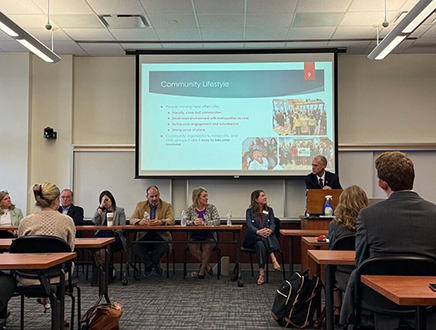
The state bar currently collaborates with West Virginia University (WVU) College of Law and other organizations to try to increase the number of attorneys practicing in rural areas. This has created initiatives like the Constitutional Scholar Exchange Program, which brings attorneys to visit high school students and encourage them to pursue law, and making an effort to educate law students on the opportunities that exist in rural parts of the state.
“Sometimes people are worried they will not be able to have a successful legal business in a small town, but our rural attorneys can attest that there is plenty of legal work to be done in even the smallest towns, and the traditional model of a general practitioner is still one that many attorneys in West Virginia use with successful results,” Baker says.
Robby Aliff, president of the state bar and member at Jackson Kelly PLLC, mentions the Supreme Court’s involvement in addressing legal deserts with mechanisms like Rule 9 and the Uniform Bar Exam score transfer, which makes it easier for lawyers from other jurisdictions to practice in the state.
Aliff says this expansion of justice is very purposeful.
“The state bar has a dedicated Rural Practice Committee, signaling that this is not incidental—it’s a strategic priority to encourage and support lawyers to locate in underserved counties,” he says.
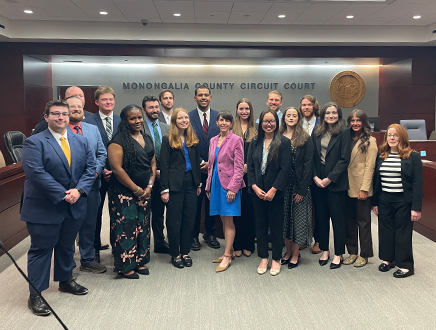
For WVU College of Law, filling Appalachia with skilled attorneys is at the heart of everything it does. Aside from its collaborations with the state bar, the college hosts a variety of ways to get students interested in practicing in rural areas.
The college’s law clinics, such as the West Virginia Innocence Project and General Litigation Clinic, provide pro bono services to many underserved communities, appearing in rural courtrooms across the state. In conjunction with the West Virginia Fund for Law in the Public Interest, the college also has the Center for Law and Public Service, where students gain experience at advocacy agencies like Legal Aid of West Virginia or as public defenders.
“We also have an active Clerkship Committee, which seeks to place students as law clerks with state court judges in rural counties, providing a pipeline to practicing law in the same area,” says Mary Claire Davis, associate professor and member of the Commission on the Future of the Practice of Law in West Virginia.
In 2017, the state bar also established the Rural Practice Scholarship at WVU College of Law, which offers tuition and fees for three years of law school in exchange for the recipient’s commitment to three years of practice in a rural area after graduation.
Madison Martin received the Rural Practice Scholarship in 2023, and has been practicing in Petersburg, WV, ever since. She says the scholarship has not only relieved the financial burden of attending law school but has also introduced her to new areas of law and shown her how they impact rural communities.
“One of the scholarship requirements is that I spread my time among various practice areas, so I’ve taken some cases I wouldn’t normally consider only because I needed to meet hour requirements,” she says. “Initiatives like this are important because they help balance out the pro/con list for rural practice.”
Martin says that as a result of the growth of legal assistance in Petersburg, she has noticed residents are more likely to ask for help.
“We see many people come through our doors looking for help with wills and powers of attorney,” she says. “I think knowing they can get these documents drafted locally has encouraged them to do so when they might not have taken advantage of that service if they had to drive a significant distance to find an attorney.”
Though rural practice is rewarding, Martin says it can sometimes be difficult finding time to fit everything into her schedule. With attorneys in legal deserts having to cover multiple counties, tasks often pile up and require a plethora of their services.
Martin is currently receiving court appointments in two circuits and five counties.
“There’s just not enough time in the day to do everything that’s needed, especially when a significant portion of time is spent on the road,” she says. “Despite that, there are many rewarding moments sprinkled throughout the day. My favorite moments are when I meet with the kids as part of my guardian ad litem duties. I’ve been beaten at many Uno games in school counselors’ offices. Those are the best parts of my day.”
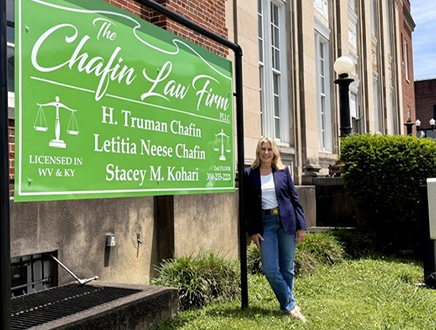
Tish Chafin, managing partner at The Chafin Law Firm in Williamson, WV, echoes this, saying it can be difficult for clients to travel to hearings and depositions in rural areas. She says to address these barriers and bring more lawyers to legal deserts, more encouragement and support is needed.
She explains that it is important for local lawyers to join public offices to educate future lawyers on the benefits of practicing in a legal desert and says increasing public defender fees could help motivate attorneys to return home to practice.
“Abuse and neglect cases unfortunately make up most of the cases on the docket in every circuit in the state,” she says. “Having enough attorneys to provide representation to individuals in legal deserts is an important right that everyone deserves regardless of where they live.”