


West Virginia’s health care industry has grown significantly in recent years, and higher than average growth is expected to continue for at least five years. In contrast, West Virginia suffers from a very low rate of labor force participation and a shrinking population. This gives rise to potential shortages in the health care workforce in coming years. A potential shortage could be a serious concern if it reduces the quality of care in the Mountain State and forces West Virginians to travel out of state.
Findings reveal a growing gap between workforce needs and in-state educational output within the health care industry. This analysis projects the need to hire 12,662 health care workers annually in the coming years. In contrast, West Virginia’s educational programs are expected to produce just 3,779 qualified graduates per year.
The heart of this analysis is a comparison of the supply of health care professionals produced in West Virginia compared to the demand for health care workers in the state. The goal is to highlight any potential shortfalls in the health care workforce that may emerge in coming years.
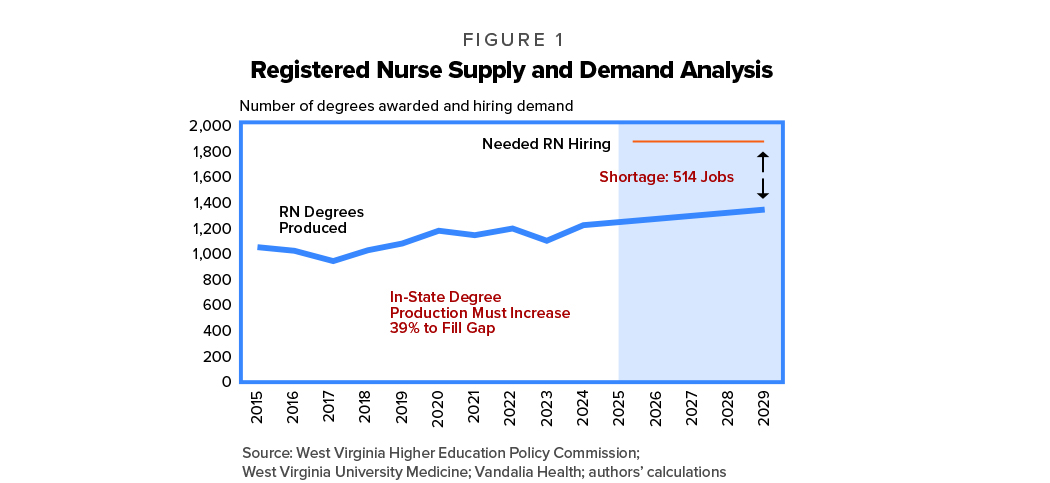
To estimate the supply of health care professionals in a particular area or in total, the analysis begins with the related degrees produced by the state’s colleges and universities, as reported by the West Virginia Higher Education Policy Commission (WVHEPC). Consider Figure 1, for example. Here, the supply of registered nurses (RN) for the years 2015 through 2024 is based on data from the WVHEPC. To extend this figure through 2029, the average annual growth rate of RN degree production from 2016 through 2024 is calculated and applied to the subsequent five years. Essentially, this approach assumes the same pattern that persisted over the last decade will continue for the coming five years.
The demand side of the analysis relies on hiring projections for total health care employment and various fields within health care that were provided directly from human resources officers at Vandalia Health Network and WVU Medicine. These two organizations comprise approximately 77.8% of the health care sector in West Virginia. As such, the analysis combines the projections from the two organizations and multiplies the combined figure appropriately to estimate total employment demand for the state for each given employment category. Therefore, projections assume the employment trends for the remaining 22.2% of the health care industry in West Virginia will follow the average pattern between Vandalia Health Network and WVU Medicine.
It is important to note these projections assume all vacancies will be filled in coming years. However, currently there exists a non-negligible job vacancy rate within the state’s health care industry. A projection that the supply of health care workers would be sufficient to meet demand would essentially represent an improvement over the status quo.
Based on projections from Vandalia Health Network and WVU Medicine, it is expected that the state will need to hire nearly 1,850 RNs annually through 2029. In contrast, projections in this analysis indicate the state will produce 1,333 RN degrees annually by 2029. This implies that if no West Virginia-trained RNs leave the state, it would face a shortage of 514 RNs by 2029. Further, this implies the in-state production of degrees would need to increase by 39% to fill this gap. This gap would be less severe if health care employers in the state were able to attract professionals from outside of West Virginia. Alternatively, the gap would be more severe if significant numbers of those health care professionals trained or currently employed in West Virginia leave the state.
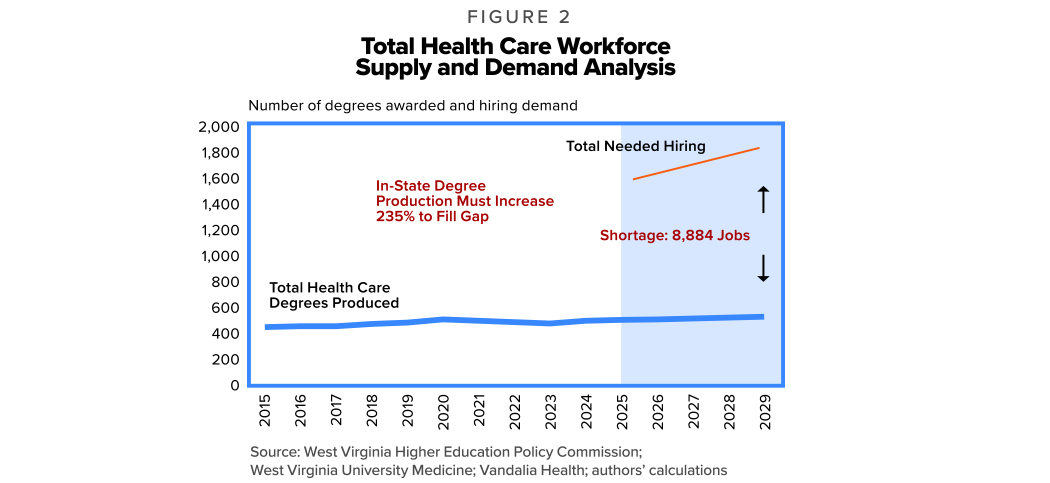
When expanding this analysis to the broader health care workforce, the challenge becomes even more significant. This finding implies West Virginia health care employers will have to look to out-of-state sources for their hiring needs.
This analysis presents a consistent and concerning picture of West Virginia’s health care workforce trajectory. It highlights a growing mismatch between the state’s ability to produce health care professionals and the projected demand for these workers in the coming years.
Health care employment in West Virginia has grown substantially and is poised to remain a leading driver of job growth. However, the state’s capacity to produce a sufficient number of qualified health care professionals, particularly in critical fields such as nursing, is falling short. Most notably, the gap between projected demand and the number of graduates produced by West Virginia’s colleges and universities is expected to widen significantly, with a projected total shortfall of nearly 8,884 health care workers annually by 2029.
West Virginia should act immediately to expand its capacity to produce qualified health care professionals. Actions such as targeted investments in degree programs, strategic partnerships with health care employers and robust retention initiatives will be critical to ensuring West Virginia can meet its growing health care needs and safeguard access to quality care for its residents.
Failure to address these workforce challenges could result in diminished health care services, increased reliance on out-of-state providers and additional pressure on an already stretched system. Proactive, data-informed action today will help secure the future of health care in the Mountain State.