

Mission Critical Materials
By Micaela Morrissette
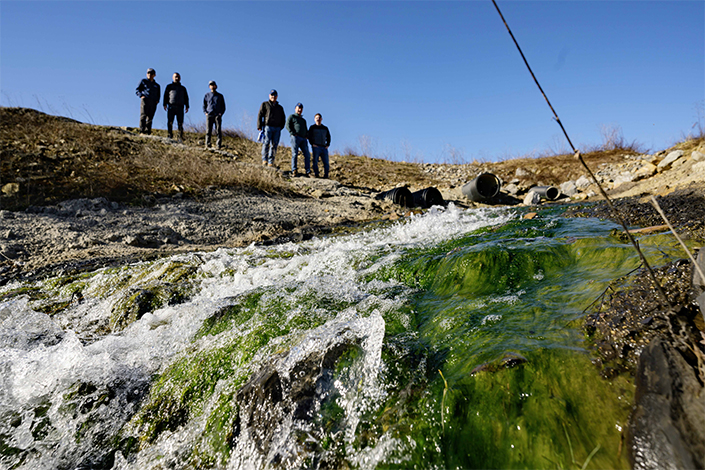
There’s something in the water in Mount Storm, WV.
Yttrium, to be precise—and dysprosium and terbium.
All three are heavy rare earth elements vital to U.S. security. All are elements the U.S. must depend on foreign powers like China to provide.
Now, thanks to a company called Mission Critical Materials (MCM) and technologies developed by researchers at West Virginia University (WVU), mining communities like Mount Storm may hold the key to sourcing those elements right here at home.
Found in acidic waters that drain off from mining operations, heavy rare earth elements like yttrium are essential for manufacturing defense systems, advanced electronics and energy infrastructure.
Acid mine drainage must be cleaned, whether it includes rare earth elements or not. The runoff at Mount Storm, for instance, is dominated by iron and aluminum, requiring perpetual treatment to neutralize the pH balance.
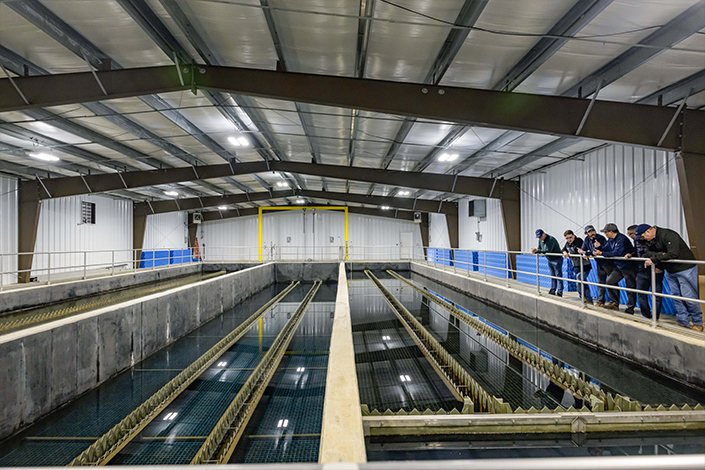
MCM’s technology integrates directly into conventional treatment systems, leveraging existing infrastructure at sites that are already permitted.
“We’re taking contaminated water, a historical environmental liability, and converting it into something absolutely critical from a strategic security standpoint,” says MCM CEO Stephen Dunmead.
MCM launched in December 2025, and in early 2026, the company partnered with REalloys, Inc., to create a supply chain that will deliver rare earth elements extracted
from mine waste directly to manufacturers of magnets used by entities like the U.S. Department of Defense (DOD) and U.S. Department of Energy (DOE).
“Yttrium, dysprosium and terbium are not currently produced in meaningful quantities in the U.S., so we’re dependent on those coming from overseas,” Dunmead says. “Disproportionately, they’re critically important for defense and other technologies like electric vehicles.
Yttrium is used in thermal barrier coatings inside modern jet engines and in crystals for laser optics. Without dysprosium and terbium, high-temperature magnets start to lose their strength, and that’s not something you want happening in the propulsion system of a fighter aircraft.”
U.S. hard rock mining of rare earths is concentrated on light rare earth elements, which are also very important for magnets. According to Dunmead, a typical hard rock mining deposit of rare earth elements in the U.S. has just a fraction of a percent of heavies.
“When MCM extracts rare earth elements from coal acid mine drainage, we’ve got 45% or 50% of heavies in there,” Dunmead says. “A lot of money goes into new hard rock mining, a lot into magnet manufacturing, but none of that addresses the problem of these three heavy rare earth elements. That’s our niche.”
MCM’s story began in 2015 with a group of WVU researchers that developed a technique for decontaminating acid mine drainage and saw potential for converting an environmental remediation problem into a high-value resource.
With the DOE and the West Virginia Department of Environmental Protection behind them, the researchers developed A34, a Mount Storm pilot facility that would eventually convince Dunmead that their technique worked.
At the urging of the DOD, they went to Montana and demonstrated that the technique wasn’t limited to runoff from coal mining but could extract heavy rare earth elements from hard rock acid mine drainage, too.
With the support of the WVU Office of Innovation and Commercialization, they realized the research was ready to make the leap from the lab to the real world.
Retired Major General James Hoyer, a member of the MCM board of directors and former vice president of economic innovation at WVU, says that decision was a great example of taking applied research and spinning it into economic opportunity.
“We needed to stand up a private-sector entity to commercialize this, and that’s how MCM was born,” Hoyer says.
In Hoyer’s eyes, the creation of MCM marks a shift in how WVU approaches the commercialization of research discoveries.
“The launch of MCM has changed the paradigm of how WVU leverages its land-grant mission and how the university spins off important intellectual property for the greater good of the state,” he says. “West Virginia must grow its economy, and WVU is helping make that happen more efficiently, more effectively and in a completely different construct than ever done before.”
Dunmead echoes this statement.
“What I saw at the A34 pilot facility gave me the confidence this isn’t a science project,” he says. “This isn’t a lab experiment. This works, and it’s time to deploy it commercially.”
Like Dunmead and Hoyer, MCM Board Member Tom Heywood has seen plenty of startups come and go.
The chief of staff to former West Virginia Governor Gaston Caperton, Heywood has watched, and sometimes helped shape, the development of the state’s economy and energy industry over his decades-long career as an attorney and lobbyist.
In his experience, the perfect confluence of right place, right time is rare indeed. Heywood believes MCM found that sweet spot by launching after state legislation was enacted that created tax incentives for rare earth recovery and clarified ownership of the recovered elements.
That bill, passed in 2022, stated whoever recovers the rare earth elements from an acid mine drainage site owns those elements. It offers companies like MCM assurance that if they recover these rare earths, they own those elements and can seek to commercialize them.
“Think of a business model where West Virginia becomes an important part of a larger domestic supply chain of rare earths, from extraction and processing to applications like defense,” Heywood says. “It’s an opportunity to become part of a critically important future industry for our country and to have a large focus of that activity here in West Virginia, where a lot of the groundbreaking research occurred.”
A transaction and economic development lawyer for over 40 years, he calls the opportunities he’s seeing on his desk these days staggering in terms of the size and quality of investments coming into the state. The momentum that’s building reminds him of decades like the ’50s and ’60s.
“It’s been a long time coming, but this is the moment,” he says. “Think about the value being created by MCM through the lens of our state’s industrial tradition, craft tradition, energy excellence and excellence in chemistry. All those long-standing assets are coming to bear at this point in time. This is how West Virginia was built. We’re potentially heading into a real golden age for West Virginia, and we’re seeing the early stages of that with investments like MCM.”